
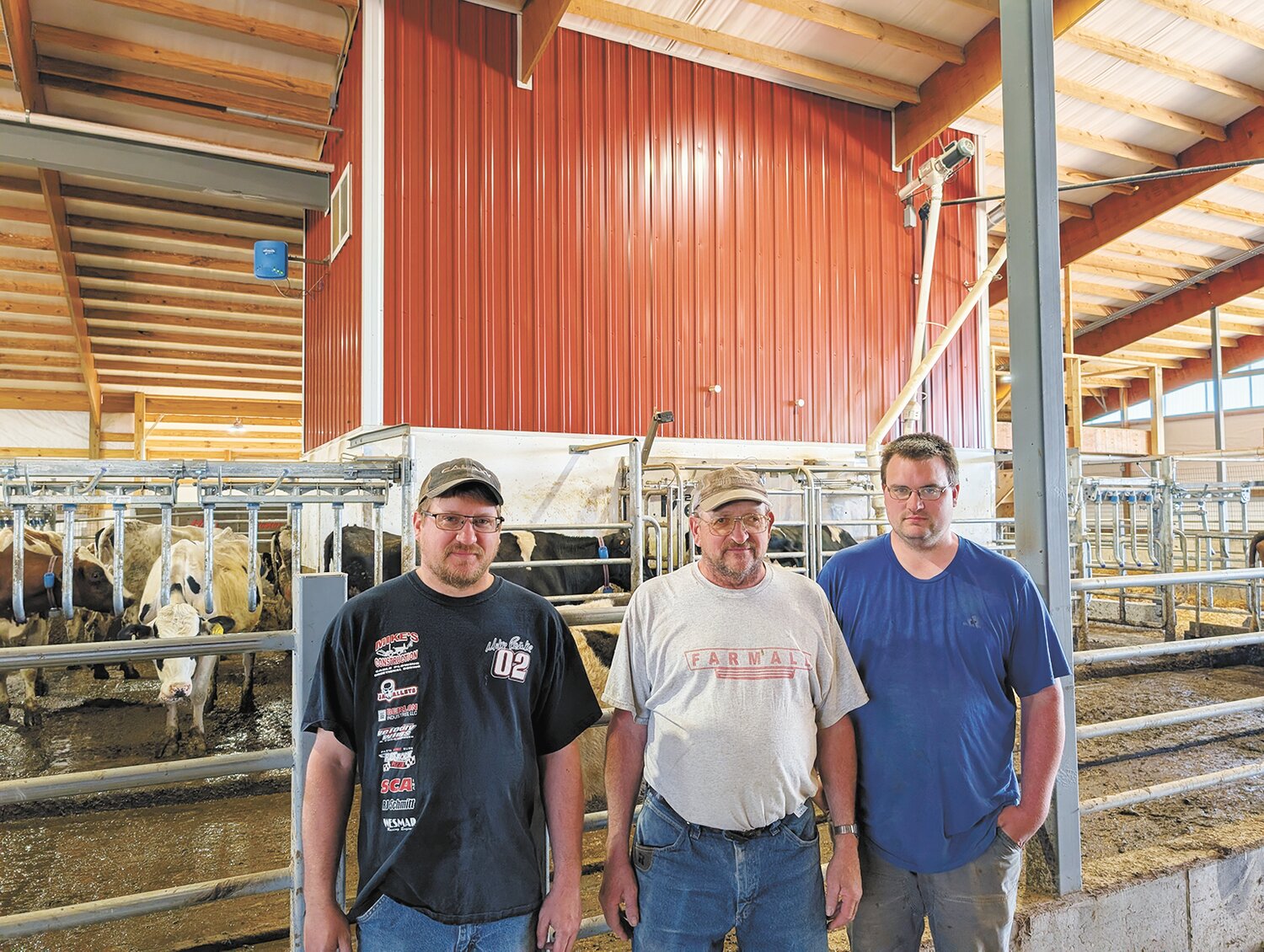


LUXEMBURG, Wis. — This past winter, cows at Zellner’s Dixieland Dairy LLC were introduced to a new way of milking when they transitioned from a tiestall barn to a robotic barn. On Feb. 9, brothers Ryan and Corey Zellner and their parents, Dave and Brenda, began milking their 100-cow herd with two AMS Galaxy Merlin 2G robots.
It was the robot’s simplistic design that appealed to the family most.
“I toured a farm in Iowa that had this model, and I really liked how quiet and simple it was,” Ryan said. “It was amazing how well it attached and how well the cows did.”
On June 23, the Zellner family will host an open house from 10 a.m. to 2 p.m. on their farm near Luxemburg.
The Zellners have been planning their robotic facility since 2018 while milking in a tiestall-stanchion barn and housing cows in a freestall barn.
“The stanchion barn was getting tired,” Dave said.
A new facility was inevitable, and when the Zellners were looking to expand, they decided robotics was the way to go. Allowing the family to be more efficient and flexible with their time was a chief reason for selecting robotic milking.
“It’s cut down on chore time quite a bit,” Ryan said. “We don’t have to go out as early in the morning, and night chores are down to two hours. It’s a lot less labor intensive.”
Ryan and Corey are the third generation on the farm their grandpa purchased in 1955. The Zellners also farm 600-700 acres, which includes their own acreage as well as custom work they do for a nearby hog farm. The Zellners compost all their bed pack manure and use it to fertilize their soybean, corn and hay fields.
To determine the best automated milking system for their operation, the Zellners visited numerous farms with robots.
“I toured 10 farms in Pennsylvania and at least 10 farms around here,” Ryan said. “We spent a lot of time figuring out what we want to do and how we want to do it. We went through a lot of plans.”
The Zellners have been breeding cows for robotic milking for the past seven years. Although some udder and teat styles are still challenging for the robot, Ryan said Merlin 2G gets it right 98% of the time.
“We maybe have one milking failure per day,” he said. “We are 10 seconds under what Galaxy wants us to be for attach time.”
The ability to provide their own feed for the robot was a driving factor in choosing this model. Instead of pellets, cows receive high-moisture corn and roasted soybeans in the robot. A high-moisture corn feeder distributes the feed when a cow eligible to be milked enters the robot.
“We didn’t have to change feed or our cropping program,” Ryan said. “Everything was the same, and we don’t have to buy pellets to draw cows in.”
The Zellners said cows have adapted well to robots and are averaging 2.5 milkings per day. The robot does two preps totaling 90 seconds per cow before attaching the milking machine.
Somatic cell count is the same as it was in the tiestall barn, with an average under 100,000 since March 1.
When building their new barn, the Zellners started with a pre-existing structure. Built 14 years ago for housing heifers aged 6 months and up, the Zellners added onto the south and west sides to create their robotic facility. The barn now measures 256 feet by 120 feet and contains 112 free stalls for milk cows, which are housed in one group.
The barn also includes a maternity pen and a special needs-fresh cow pen where animals are housed on a bed pack. The barn features natural ventilation with fans positioned over the free stalls. Incorporating longer stalls and better ventilation, Ryan said the new barn offers superior cow comfort compared to their older barns.
The robots are positioned side by side with a left model and a right model set up in a free-flow system. The Zellners said they like the compact design of their robotic milking system, which allowed them to condense the size of the barn into a smaller footprint.
“We probably saved 40-50 feet with this layout,” Dave said.
Their model features K entry and exit, enabling cows to exit from the front or the side. The site of departure depends on whether the cow is being sorted into the special needs-fresh cow pen.
“We don’t need an extra set of gates to do that,” Dave said. “Also, man passes are very important. You would be surprised how much time it saves. You can get in easily and quickly if you have to. Little things like this matter.”
The Zellners’ Holstein herd, which includes Red & Whites, will grow by a total of 30 cows in the new setup. They added 10 more when switching to robots, and another 20 will be added in the coming months as the Zellners grow their herd from within.
“Our costs haven’t really gone up,” Ryan said. “Feed costs stayed the same. Electric cost has not increased by much, maybe $200 total from the old barn to this.”
Making the barn longer or one bay deeper is one change the Zellners said they would make in hindsight.
“We would have liked the maternity and special needs pens to be larger,” Ryan said. “They are 14 feet by 50-plus feet, which is a little small.”
In the future, the Zellners would like to add more automation to their barn.
“A feed pusher would be the next thing and more automation with our manure pump so we don’t have to run it ourselves,” Ryan said. “We would also like to add alley scrapers on the heifer side.”
 |
 |
 |
 |
Share with others


Comments
No comments on this item Please log in to comment by clicking here