
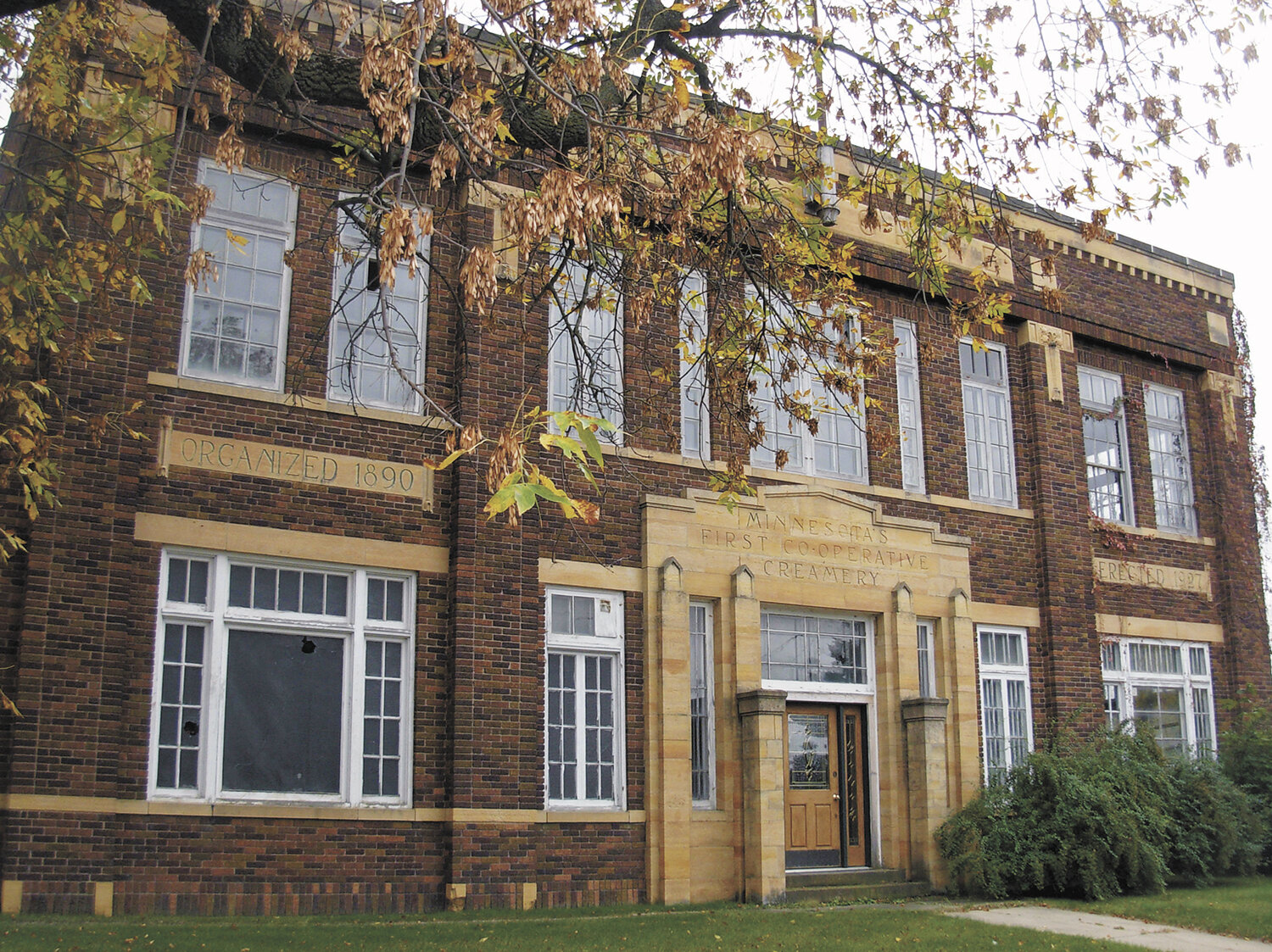


CLARKS GROVE, Minn. — In the town of Clarks Grove, a historic brick building’s wall is emblazoned with the words, “Minnesota’s First Co-operative Creamery.” Whether Clarks Grove Co-operative Creamery Association was the very first cooperative creamery in the state is up for debate. Regardless, the organization was a pioneering example of a new way to process and market milk for Minnesota’s dairy industry in the 1800s.
The movement in Freeborn County all started with a Danish-American immigrant, Hans Peter Jensen. H.P. Jensen brought his family to the U.S. in 1862, settling first in Wisconsin and then moving via oxen team to Minnesota in 1864.
In 1884, Jensen returned to Denmark for a visit after hearing about the Danish farmers’ dairy cooperatives in a letter.
Notes from Jensen’s family include details of what he experienced.
“At the time of his immigration from Denmark, the county was poor because of an impoverished condition of the soil,” the notes read. “It had now become highly productive and the people prosperous, apparently wholly due to the development of dairying along co-operative lines.”
H.P. Jensen returned to Freeborn County full of ideas, which first came to fruition in 1890. His family’s notes bring more information about the early proceedings.
“It was only through his persistent and untiring advocacy of the project that, finally on January 28, 1890, at a meeting in the little neighborhood church, opened with prayer, the members of the community agreed to undertake the organization of the Clarks Grove Creamery.”
Jensen was a strong Baptist and a dairy farmer. His great-great-grandson, David Jensen, was the last in the family line to dairy, selling the cows in the 1970s.
“My dad served on the creamery board for many years, and that’s where all our milk was delivered to, the Clarks Grove Creamery,” David Jensen said.
According to an article by Kathy Jensen in the June 14, 1990, Albert Lea Tribune, before H.P. Jensen and his fellow farmers started processing milk, two locals, J.P. Larson and L.P. Lawson, were sent to visit cooperative creameries in Iowa. Clarks Grove ended up patterning their creamery after a cooperative the pair visited in Freemont, Iowa. However, Kathy Jensen noted that, unlike Freemont, at Clarks Grove they decided to keep the creamery closed on Sundays, which remained in effect until 1934.
“There shall not be received any milk or any work or business done in the association’s creamery on Sundays,” the bylaws read.
The creamery opened in 1890 with 82 patrons, according to Kathy Jensen. In an article by the Freeborn County Standard dated July 9, 1890, the creamery was making about 670 pounds of butter a day from 14,000 pounds of milk.
“A lot of the farmers signed up for it, and farmers brought all their milk to the creamery,” David Jensen said.
Whether or not Clarks Grove had the first dairy cooperative in Minnesota is unclear. There seem to be several that opened or had their first meeting slightly before Clarks Grove Co-operative Creamery Association. A St. Paul Pioneer Press article from April 24, 1949, mentions five cooperatives that claimed the honor. Vernon and Zumbro met in January 1889. However, after arguments over where the creamery was to be located, they split off and started two separate creameries in May 1890. The article states that the Biscay creamery was assembled Feb. 7, 1889. The Chatfield creamery was organized Dec. 27, 1889.
Nevertheless, H.P. Jensen was influential in developing the cooperative concept and was recognized Jan. 6, 1917, by the University of Minnesota with a formal testimonial for his contributions “in the development of agriculture and in country life affairs.”
One of the professors in the U of M’s department of agriculture, Theophilus Levi Haecker, traveled across Minnesota, encouraging the development of cooperative creameries and touting Clarks Grove Co-operative Creamery Association as an example, according to an article by R. L. Cartwright for the Minnesota Historical Society’s online encyclopedia.
In the Freeborn County Standard’s Jan. 11, 1917, coverage of H.P. Jensen’s testimonial from the U of M, this was written about Haecker’s estimation of Jensen.
“Mr. Jensen has done much to further co-operative dairying, and Clarks Grove creamery leads off in Minnesota’s achievements in co-operative dairying,” the article reads.
The creamery building standing today is not the one H.P. Jensen would have known. The first facilities were updated at a cost of $9,000 in 1905, according to Kathy Jensen. The current building is from the late 1920s.
Originally, according to Kathy Jensen, the creamery used ice harvested from Geneva Lake for its refrigeration system. Ice was packed in sawdust to keep year-round and local farmers hauled it to the creamery. In 1912, according to a Freeborn County Standard article dated Jan. 17, 1912, the creamery decided to put in a plant to produce ice to eliminate harvesting and hauling.
In 1927, the Duluth Herald dated April 19, 1927, reported a fire destroyed the updated creamery building. The estimated loss was $50,000. According to Nancy Jensen, the building standing today was built of brick to be fire resistant.
The new building had a large upstairs room used by the community for events such as pancake meals, school Christmas programs, and piano lessons and recitals, according to Kathy Jensen. In 1956, she writes that the room housed classes when the local school burned.
“It was always open,” David Jensen said. “People could go in there, in the upstairs of the creamery. … As a Cub Scout, we had our meetings upstairs.”
The Clarks Grove Co-operative Creamery Association was not the only milk processor in the area. In 1910, according to research about agriculture in Freeborn County by Roger Lonning, Freeborn County had 28 creameries servicing 2,728 patrons and 27,253 cows. County butter production was over 5 million pounds.
In November 1912, the creamery was paying just over 40 cents a pound for butterfat, according to a Freeborn County Standard article dated Jan. 1, 1913. In 1917, the creamery was paying over 50 cents a pound for butterfat the same paper reported in a Jan. 31, 1918, article. Adjusted for inflation, this would equal about $11.85 per pound for butterfat. In October 2025, over 100 years later, according to the U.S. Department of Agriculture, the butterfat price was around $1.82 per pound.
According the annual report for 1917 printed by the Freeborn County Standard Feb. 18, 1918, the creamery produced 324,246 pounds of butter from 519,978 pounds of milk. In 1925, the creamery had the largest butter production of any creamery in Freeborn County, according to an article by the Freeborn County Standard dated Feb. 12, 1925.
In 1996, over 100 years after it began, the creamery closed its doors according to Cartwright. David Jensen received a check for $81.60 in May 1997 for his remaining stock. Today, though the creamery is closed, the cooperative processing model continues across Minnesota’s dairy industry.
Sources:
— Jensen family records
— Albert Lea Tribune, June 14, 1990
—Freeborn County Standard, July 9, 1890; Jan. 17, 1912; Jan. 1. 1913; Jan. 11, 1917; Jan. 31, 1918; Feb. 18, 1918; Feb. 12, 1925;
— St. Paul Pioneer Press. April 24, 1949
— MNOPEDIA. Clarks Grove. By R.L. Cartwright.
— Duluth Herald. April 19, 1927
— Agriculture in Freeborn County. Dairying, 1880-2005. By Roger Lonning.
— U.S. Department of Agriculture Agricultural Marketing Service. Final Class Prices by Order. Nov. 5.
 |
 |
 |
 |
Share with others


Comments
No comments on this item Please log in to comment by clicking here