
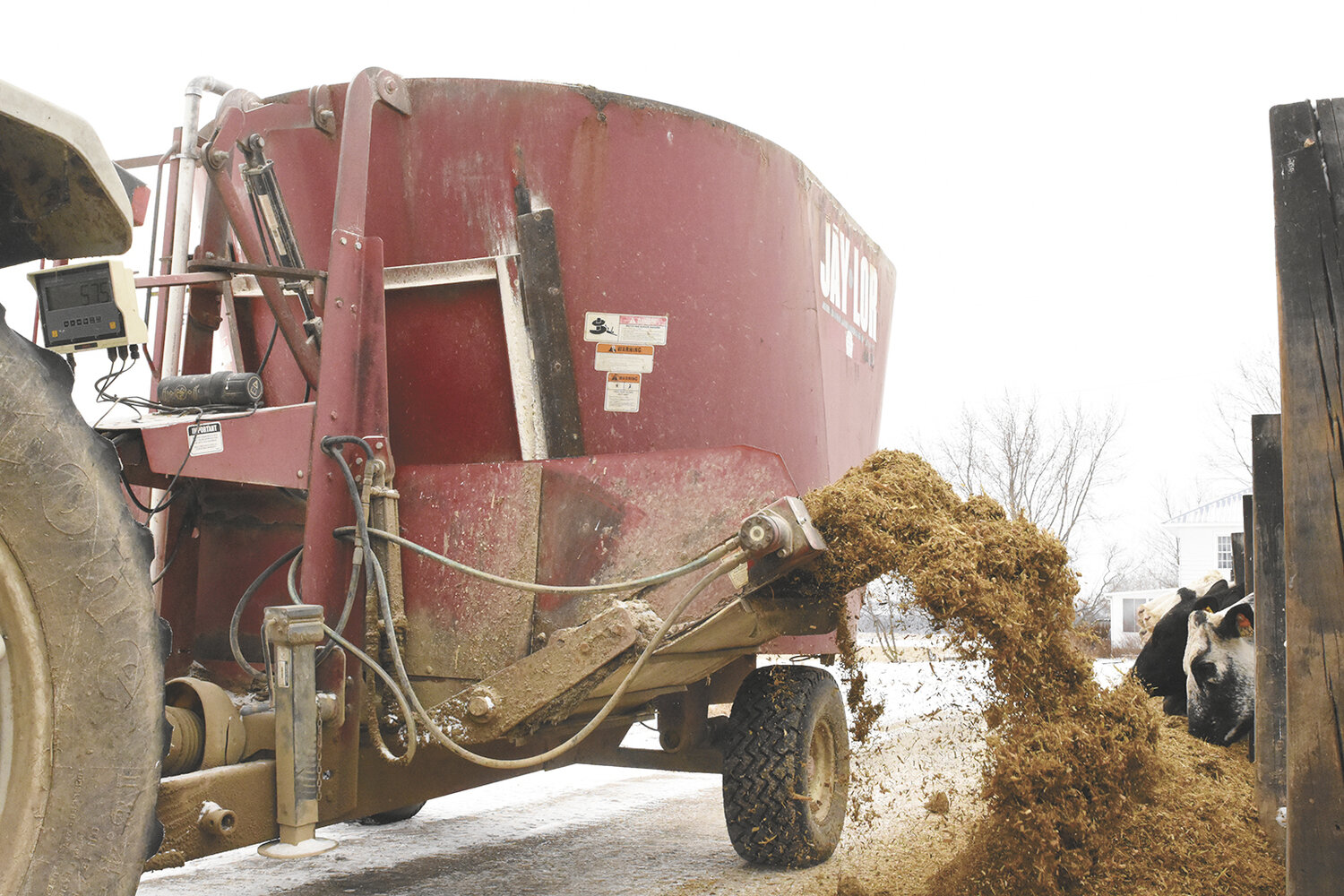


Editor’s note: Information for the article was provided by Jenna Neuheisel, a consultant with Ag Consultants Team Inc. in Sparta, Wisconsin, Steve Gerke, a territory manager at Roto-Mix Inc., and Chuck Friedley, a retired salesman from KUHN North America Inc., along with independent research.
One of the great revolutions of the dairy industry is the introduction of the total mixed ration. Although commonplace in today’s enterprise, TMR faced skepticism when it was first introduced. The concept — every nutrient a cow needs in a single bite — evolved and is now regarded as one of the most efficient ways to feed cattle.
When TMR was launched, component feeding, still utilized today by some dairies, was the most popular form of feeding. It individualized diets by cow but brought about a different set of challenges with inconsistency in ration and consumption.
Component feeding features more estimation per cow. Without the use of scales to accurately measure the amount of ingredients given to each cow, the ration can vary depending on the feeder.
TMR eliminates that estimation and is more concise, ensuring each mouthful is balanced. It also helps dairy producers better use lower-quality forages because they are blended with better forages in a way cows cannot sort. Nutritionists have also found that a TMR mix can help improve a cow’s rumen health.
“We’ve seen increases in components and a more level rumen pH with a TMR feed source because it’s not just all grain being eaten at one time,” Jenna Neuheisel said.
Neuheisel is a consultant with Ag Consulting Team Inc., working with herds in western Wisconsin.
When TMR was first introduced in the 1950s, dairy producers doubted its value. The beef industry had already started implementing TMR strategies early and had seen improvements in their cattle. However, promoting a single ration for the majority of a dairy herd was not commonplace.
With TMR mixed for the top 75% of the herd, it gave cows the ability to eat more. Higher producers consumed more of the ration, leading to an increase in production. With production increasing with the new style of feeding, farmers began attempting to implement it how they could.
Implementation was difficult during early years because dairy farms were not set up to allow TMR mixers to feed directly. Some smaller farms began to utilize tumble mixers because of their ability to maximize feed that was housed in silos. Expanding beyond stationary mixers often required feeding systems to be restructured.
As these barns were phased out on some farms in favor of freestall barns, the transition to full TMR feeding was underway in the dairy industry. In these new setups, component feeding was impractical. Barns were constructed with drive-through feed areas to help improve the speed of feeding and to incorporate the new TMR style.
The evolution of trailer mixers and truck mixers made feeding more efficient in the new barns. Nutritionists played a vital role in the growth of TMRs too as they helped producers determine which mixer was best for their farm.
“In those early years, we’d hold meetings where we’d have specialists come in and teach producers how the TMR would work for them,” said Chuck Friedley, a retired salesman with 43 years of experience in implement sales. “We’d discuss the right mixer for each farm and give them a trial to use the new mixer.”
Friedley sold TMR mixers of multiple kinds across his career. He retired in 2022. He spent the last 20 years of his professional career working with KUHN as the salesman for a territory that included North and South Dakota, western Minnesota, northwest Iowa and northeast Nebraska.
Friedley said TMR mixer trials lasted six months. This was long enough for the farm to work through the initial challenges and see what the TMR mix could add to the herd.
“If the mixer didn’t work out in that trial period, we’d take it back,” Friedley said. “There were only a handful that we needed to take back. Most people who started using them learned how to make it work for their herd.”
As TMR mixers began to take hold in the Midwest, the variation of styles became even more important. Deciding whether a farm should use a reel mixer, an auger mixer, or a tumble mixer was dependent on each farm, their goals, forages and even the terrain.
“We always had to find out what the farmer was feeding,” Friedley said. “That helped us determine what would work best for them.”
Early adaptations of TMR mixers saw reel mixers being more heavily used. This evolved to horizontal mixers in the 1980s to the eventual vertical mixers gaining popularity in the mid to late 1990s.
A major issue when adapting to TMR feeding was overmixing and decreasing particle size. Reel mixers were initially the most popular style of mixer, especially in the early days because it was more forgiving in terms of over-processing, using fewer blades to mix feed.
Horizontal mixers owned most of the market during the 1980s because of their quicker mixing times. A drawback to that quicker mix was that it made it easier to overprocess the mix. Horizontal mixers also struggled with hay processing, which led to the evolution of the vertical mixer.
Vertical mixers took hold of the market during the 1990s and still hold most of the market today. The new development is the most efficient way to process hay, allowing nutritionists to continue to add dry hay to the ration.
Hay processing has been a challenge for TMR mixers and has factored heavily in the evolution of machine design.
Friedley said farmers learned more about each mixer over time, and which style suited their farm best.
“Those six-month trials were knocked down to three or four days when farmers were looking for their second mixer,” Friedley said. “Those trials were as important because it would prove what would work and help them dial in what kind of mixer they wanted.”
Testing new styles of mixers became an important element in the evolution of the machine. Actual performance played a key role in determining which mixer would work best.
“We’d try to think of everything with mixer design, but we really started to figure things out when we tested the mixers on the farms,” Friedley said. “We tried to account for everything, but without fail, we’d find new challenges when the mixers got on the farm.”
Continuing to develop new methods and strategies to create better feed for livestock remains at the forefront of the feed industry. With the introduction of robotic milking units, some elements of component feeding have found their way back into the metaphorical mix.
Adding TMR to dairy herds increased production and changed the way barns were built. It reshaped the dairy industry, increasing profitability through more efficient feeding. As feeding evolves, TMR mixers continue to help farmers produce more product with less time and feed waste.
 |
 |
 |
 |
Share with others


Comments
No comments on this item Please log in to comment by clicking here