




Editor’s note: A special thanks to dairy historian, Ron Eustice, for his assistance and resources in connection with this article.
RED WING, Minn. — When medical doctor Richard Bennet (R.B.) Graves of Red Wing and his wife, Ruth, started breeding Ayrshire cattle at Mor-Ayr Farm in 1949, it was the start of a dairy that would produce the highest-scoring Ayrshire ever.
The final herdsman at Mor-Ayr was dairy legend and National Dairy Shrine Hall of Fame inductee, Jerry Strandlund.
“Our pedigrees represented the top bloodlines of various different breeders … (in) America, Canada and Scotland,” Strandlund said. “We were unique … having blended all of those bloodlines together. … Our little motto of Mor-Ayr was ‘Type and production combinations from the best of three nations.’”
Strandlund worked for Graves from Jan. 1, 1962, until the herd dispersed in March 1965.
Strandlund was in charge of all the daily work of the farm, paying the bills, getting animals ready for shows and assisting with mating decisions.
“(Graves) would come out to the farm probably once a month to check things over,” Strandlund said. “Doc was a good person to work for.”
During his time at Mor-Ayr Farm, Strandlund helped show 14 All-American nominees. Beyond home breeding, Graves regularly purchased animals from other famous herds in the U.S. and Canada.
“He could buy about anything he wanted to,” Strandlund said.
Strandlund said Graves was willing to spend on genetics.
“He had invested early on in the Minnesota Mining and Manufacturing company (3M), and he made a lot of money there,” Strandlund said.
Mor-Ayr Farm also sold genetics. A local sale of Mor-Ayr Stella Ann to Carl and Edward Holmes of St. Cloud was important enough to make the July 22, 1963, edition of the St. Cloud Times.
The highest ever classified Ayrshire in the U.S., Mor-Ayr Bell Belidina, was scored Excellent 97.2 according to the “Famous Farmers of Minnesota, Volume 1” written by dairy historian, Ron Eustice, and published in 2023. Strandlund helped with the mating. Belidina was on the cover of the November 1970 Ayrshire Digest, to recognize her grand champion honors at the Eastern States Exposition, World Dairy Expo and the North American (National Ayrshire) Show.
According to Strandlund, the average type on classification at Mor-Ayr was Very Good 87.5 in 1964. At one point in Strandlund’s tenure at Mor-Ayr, Eustice in “Famous Farmers of Minnesota” writes that Mor-Ayr was the highest average classified herd of any breed in Minnesota.
Each year Mor-Ayr cattle would attend the Minnesota State Fair, the Dairy Cattle Congress in Waterloo, Iowa, and the International Live Stock Exhibition in Chicago, Illinois.
“I love to show cattle, and going to the various fairs was always a big deal,” Strandlund said. “It was always good to visit with the breeders. … You learned a lot about what was going on, which bulls in the breed were doing a good job.”
Mor-Ayr cattle were also shown locally at the Goodhue County Fair. A Rochester Post Bulletin article from July 29, 1961, said the junior, senior and grand champion Ayrshires of the fair were from Mor-Ayr.
“We gained a lot of acknowledgements and a lot of prestige from the winnings (at shows),” Strandlund said.
Graves also volunteered in the dairy community. According to a Rochester Post Bulletin article from May 18, 1959, Graves was the director of the Minnesota Ayrshire association and had just been elected as the vice president of the national Ayrshire breeders association.
Back home on the farm, Strandlund’s day started with milking and chores, cleaning the barn daily and putting down fresh bedding. During the summer show season, high school kids helped with extra work.”
“One of the tasks we did that I was pretty particular about was washing the tails every morning,” Strandlund said. “They were presented in pretty nice order every day.”
The farm had a few visitors each week Strandlund said. Visitors who arrived found a barn with spacious tie-stalls housing the herd of 30 milking cows.
“It was always a pleasure to show visitors the herd and visit about pedigrees,” Strandlund said.
Strandlund had grown up on a dairy farm with 19 grade Holsteins near Mora. In high school he became interested in registered in genetics. He went to college at the University of Minnesota to pursue a degree in animal science. Over his summers, he did four internships at prestigious dairy farms: Hugo Albrecht in Minnesota, Carnation Milk Farms in Washington, Pineyhill Farm in New Jersey, and Elmwood Farm in Illinois.
When Strandlund graduated, a friend he had made at the U of M, L.H. “Lew” Conlon, manager of the Minnesota Dairy Industry Committee, and a friend of Graves, helped him get the job at Mor-Ayr.
“I was 23 years old then, and that was quite a responsibility,” Strandlund said. “There weren’t too many job openings in those days for people to go to work as herdsmen or managers for purebred dairy cattle establishments, at least the ones that were … owned by people with a lot of money.”
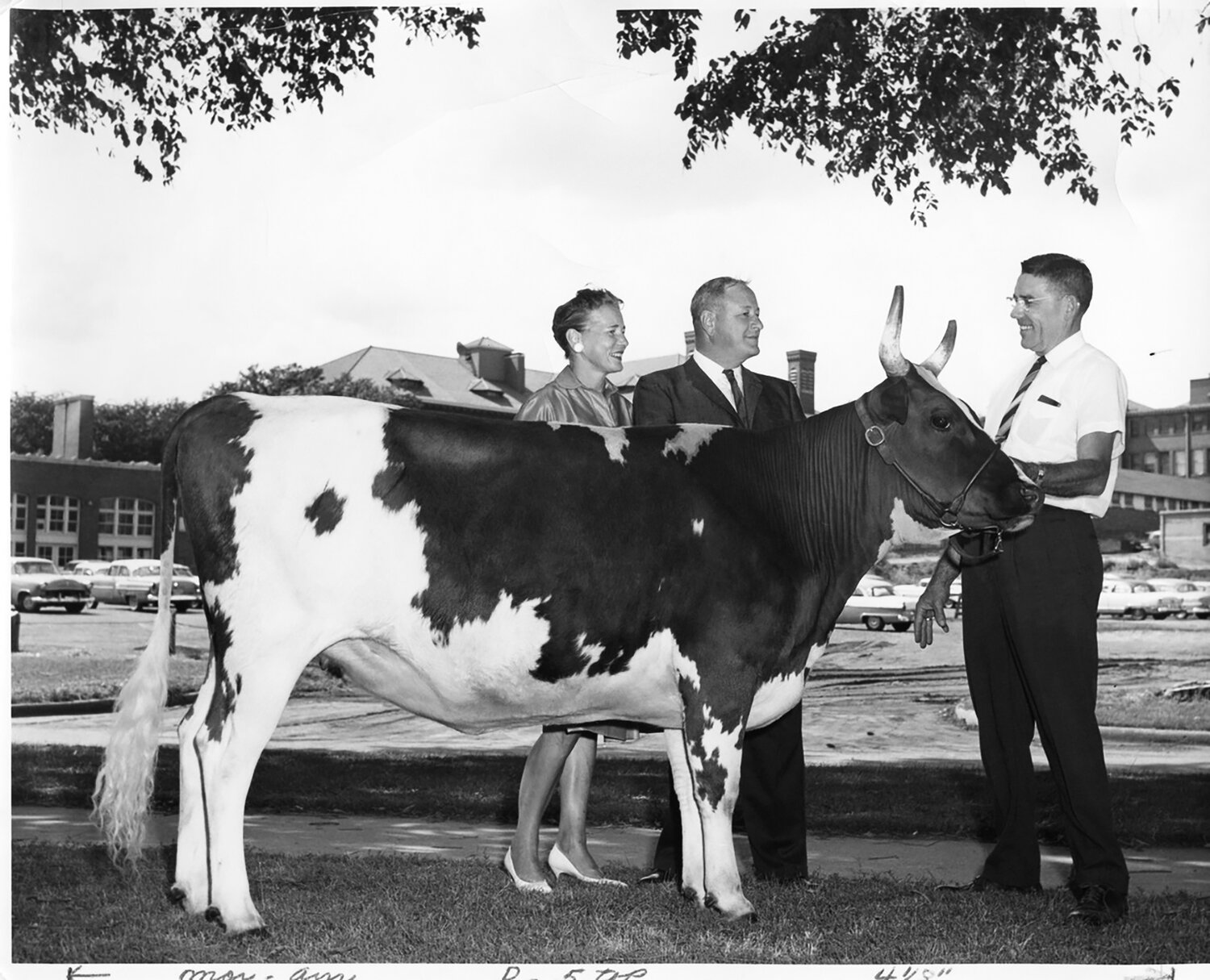
In 1963, Mor-Ayr was in the spotlight when one of their Ayrshires, Ayr-Line Fashion Pat, was selected as the June Dairy Month Mascot to make multiple publicity appearances. According to the press release below a photo of Pat and Princess Kay of the Milky Way, Kathy Hjelle, printed in newspapers around the state, Pat was the official hostess of a luncheon to kick off June Dairy Month held May 21 at the glamorous Lowry Hotel in St. Paul. A year later, in 1964, according to “Famous Farmers of Minnesota,” Pat again served in celebrity status at a dairy farmer appreciation night dance at the Prom Center in St. Paul alongside Princess Kay Audrey Meyer.
These were not the first of Pat’s accolades. Classified Excellent 92 according to a July 15, 1963, Ayrshire Digest article included in “Famous Farmers of Minnesota,” she had a high honorable mention All-American in 1962 and was the All-American Three-Year-Old in 1961. She also had grand championships at nine state fairs as well as the Minnesota State Fair and the International Livestock Exposition. Strandlund said he was proud to have won the herdsmanship award for the Ayrshire breed at the National Dairy Cattle Congress show in 1964. This award was presented to an individual of each breed at the show.
On March 25, 1965, the herd was dispersed. Buyers came from the East Coast, Montana and Canada. According to an article in the May 15, 1965, Ayrshire Digest included in “Famous Farmers of Minnesota,” the sale was attended by 400 people amid subzero temperatures and heavy snow. The top-selling cow, Meredith Bruis, sold for $3,400, or about $35,000 today.
“The barns were pretty quiet for the week afterwards,” Standlund said. “It was sad to see all those animals disappear in one day.”
The Graves family also donated 10 registered Ayrshires to the University of Minnesota to start the Ayrshire herd in 1965, Eustice wrote.
The Mor-Ayr legacy continued after the dispersal. Two of the animals sold on the sale went on to win grand champion at national shows, including a win at World Dairy Expo in 1967, Strandlund said.
Strandlund went on to work at various positions in the dairy industry, started a cattle photography business, Bovagraph, and was the owner and editor of the Northwest Holstein News and other publications before retirement.
 |
 |
 |
 |
Share with others


Comments
No comments on this item Please log in to comment by clicking here