
LAKE GENEVA, Wis. — A focus on profitability regardless of herd size or goals was the basis of a presentation given by Ben Rupchis at the American Dairy Goat Association national convention in Lake Geneva Oct. 19-25. Rupchis manages the Goat Teaching and Research Facility at the University of California, Davis and owns Bearly Dairy Goats, a herd of Alpines, Lamanchas, Saanens and Toggenburgs, with his wife.
During his presentation, “Production, Type and Genetics: The Trifecta of Dairy Profitability,” Rupchis shared ideas for improving profitability through genetic decisions.
“We can make a lot of progress in a lot of different ways,” Rupchis said. “We have strong models from other species for improving efficiency and production. When looking to make a change, we have to leverage both management and genetics.”
The advantages of genetic gain include increased output, efficiency, sustainability and marketability.
“We want to create a healthy animal with a long, productive life,” Rupchis said. “When we use genetics to expand the health and production of our animals, that expands our marketability.”
Tens of thousands of goats have been appraised over the years, providing a large historic data set. Rupchis said there is a modest baseline in dairy goats with significant room for progress.
“We’ve made impressive progress already in structural type, but there are other things we can turn our eye to and put emphasis on,” he said.
The benefits of a buck’s genetics can be seen relatively quickly because the generation interval between goats is short, especially compared to cows.
Rupchis focused on how heritability and key genetic concepts should be considered when making breeding decisions. Heritability is a measure of genetic influence on specific quantitative traits, such as milk yield and stature, as opposed to environmental influence.
“We can measure those traits very reliably,” he said. “High heritability results in more rapid genetic progress.”
Rear udder arch is a trait with low heritability, Rupchis said.
“If there is a lot of environmental influence on something, that makes it hard to breed for,” he said.
When it comes to production traits, protein has the greatest heritability, followed by pounds of milk and butterfat.
“Fat has strong environmental influences— from weather to ration changes to goats in heat,” Rupchis said. “There is definitely a genetic component, but it’s lower than protein or milk. We see tremendous genetic variation in dairy goats, which means there is also room for tremendous opportunity.”
When looking at a sire’s type and production evaluations, heritability and quantitative data are factored in to produce an estimate of the animal’s genetic merit. However, more caution is applied to data that is gathered on traits with lower heritability.
“If there’s an animal with one full lactation, and her protein is super high and fat is also pretty high, we place more confidence in her protein value because of its greater heritability,” Rupchis said.
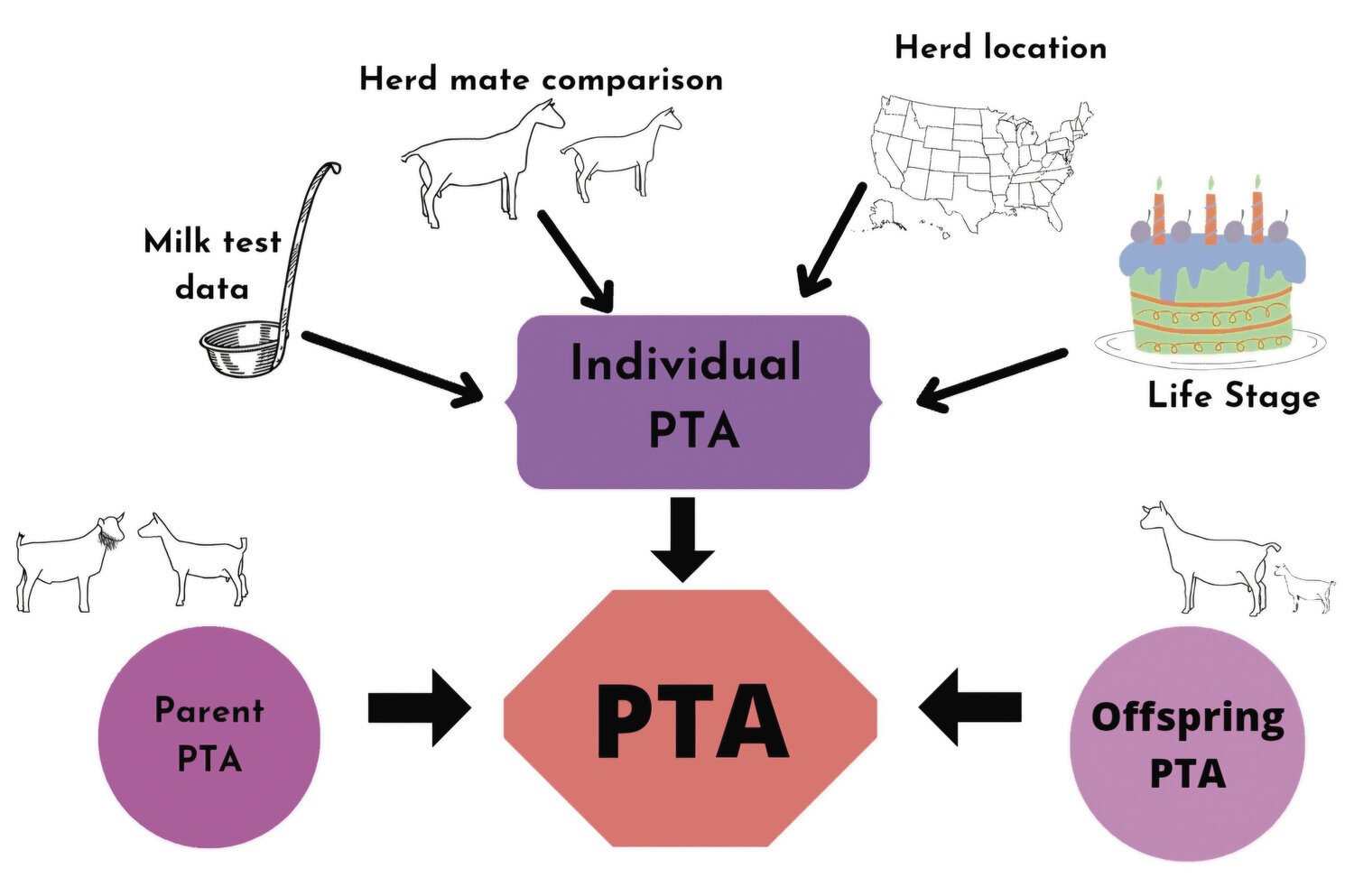
Predicted Transmitting Ability is the estimate of genetic merit relative to breed base, which allows comparison of animals within the same breed. The base is reset every five years to account for progress.
“We want to compare genetics to the present — not to 1989 when evaluations started,” Rupchis said.
Milk, fat and protein are expressed in pounds of yield as positive or negative PTAs. Fat and protein percent are also expressed as positive or negative PTAs. An evaluation of 0 would indicate a genetically average goat.
“The production data is breed-specific,” Rupchis said. “You can’t compare the PTA of a Nubian to a Nigerian, for example.”
When analyzing milk production data to calculate percentile rankings, protein is weighted most heavily followed by butterfat, then milk. Rupchis said one pound of protein is equal to about 70 pounds of milk, whereas one pound of fat is equal to about 30 pounds of milk.
“Most goat milk in the U.S. is used for cheese, and that’s what these numbers are based on,” he said. “If you just bottle milk, you can select almost entirely on milk. If you’re making cheese or selling milk to a creamery that’s making cheese and paying you based on pounds of protein, then you might want to select for protein.”
The reliability rating demonstrates the degree of confidence in a doe or buck. A goat that has been in the herd for eight years and freshened seven times will have a higher level of reliability than a goat recently purchased that kidded once and only has a couple of tests.
Reliability takes into account individual lactation data on does and progeny data for both bucks and does, including total test days, number of herds a sire has daughters in, and the number of herd mates for comparison. Rupchis said a buck that is over 60 or 70 for reliability can be used with confidence.
Though progress has been made in type in the last 40 years, there are also challenges.
“There is a lack of goat-specific research, especially in the U.S.,” Rupchis said. “We may think of certain things as desirable for type, but we don’t necessarily have data that backs that up.”
In a type assessment, certain traits can be seen visually with relative ease and consistency, such as mobility, body condition, and udder and body capacity. Other functional traits, such as milk production, somatic cell count, reproductive soundness, kidding ease, milking speed and more, cannot be captured through visual type assessment.
“We need to be mindful of what we can’t see,” Rupchis said.
A goat that maintains body condition without any tendency towards over-conditioning will exhibit greater feed efficiency and resilience to metabolic and disease challenges. In addition, a goat with ease of motion and graceful walk results in greater animal comfort and longer herd life. A goat with a strongly attached udder and capacity indicates heavy milk production over a long period of usefulness.
“Our ADGA scorecard is reaffirming some of the things we’re breeding for in production,” Rupchis said. “We must take into account from a breeding perspective what we can and cannot see in regards to production because it will drive us to some of the more desirable extremes we may see in time.”
Rupchis said a producer should identify priorities and goals and pinpoint what is efficient and profitable for their operation. They should include all selection parameters and determine selection intensity.
“You want to be as mindful of what you don’t select for as what you do select for,” he said. “Whether you milk five goats or 500, the type of dairy goat we want is one that can function efficiently over a long, productive lifetime.”
 |
 |
 |
 |
Share with others


Comments
No comments on this item Please log in to comment by clicking here