
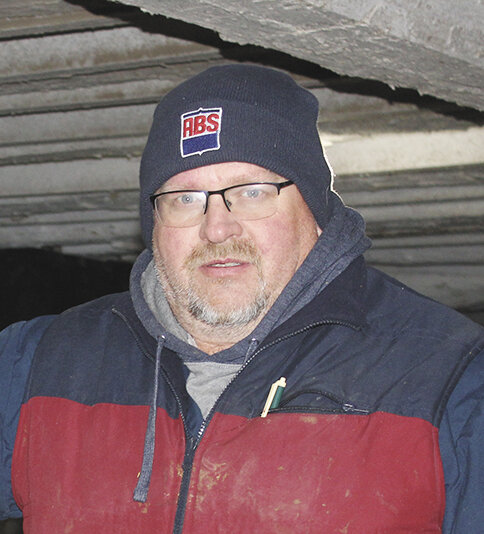
A.I. Technician
ABS Global
31 years experience
Describe your current route and how many farms do you breed at? I started this route with ABS Global in July from scratch. I cover parts of four counties — Clark, Marathon, Wood and Portage. I’m breeding at least 15-25 cows a day, to as many as 60 or 70 on ovsynch days. Generally, I do as many as 10 or 11 stops a day. I have some herds I stop at every day and some that I only go to when they call for service. My largest herd right now is around 1,100 cows.
How did you become an artificial insemination technician? It was something I had never thought I would end up doing. I went to the University of Wisconsin-Platteville and majored in technical agriculture with a minor in animal science and played football for a year and a half before I hurt my knee. After graduation I chose to get into breeding cows right away, in January, 1993. One of my teachers had worked for Midwest Breeders, which became 21st Century Genetics around that time, and he led me that way.
Describe your career path since starting as an A.I. technician. I bred cows for 21st Century Genetics until 1997, when my dad had cancer and I went home to take the farm over. The last two years I farmed I bred cows for Select Sires NorthStar Cooperative when we had $9 milk in 2002 and 2003. In February 2004, I sold the cows and I started breeding cows for Accelerated Genetics through 2010, before driving truck over the road for a couple of years. I started breeding cows again with Select Sires in 2012 until 2022, when I left breeding cows because of some health issues. I started breeding cows again as a relief technician after just under a year away from breeding. I took the job with ABS Global in July. I’m not sure exactly how many cows I’ve bred in my career, but I would estimate somewhere around 125,000.
What kind of specific training did you have to become an A.I. technician? Back then it was very different than it is now. Most herds were tie-stall and stanchion herds; the freestall herds were a rarity to breed at. They trained us at the stockyards in Green Bay. You were just arming cows and very rarely could you find one that was actually in heat. Today, they go into a large herd and they have practical cows; it’s a better way to learn for someone who has never bred a cow before. I can remember our instructor from 21st Century telling us we should find another field because what we were doing wasn’t going to exist in five years. They were pushing farmers to breed their own cows in the bigger herds. Their mindset was different in those days — that once the farms got bigger, farmers would breed their own cows. Some do, but it is a time and labor-saving mechanism on the farm to have a technician come in and take care of the breeding.
How does technology impact your work? Activity monitors are good at helping catch cows that show poor heats. They save a lot of time compared to tail-chalking. Being able to see the cows that are in heat and where they are in the barn is helpful. It also helps with the accuracy of knowing when a cow is in heat, based on more than just visual signs. After years of working with these systems, I don’t question them anymore. I do tail-chalk heifers at some of my farms.
Has HPAI H5N1 impacted the way you do your job? For me it has not changed anything — you have to make sure to keep your boots clean and disinfected, keeping everything as clean as possible. Following biosecurity protocols is always a foundation of breeding cows. You are in so many barns, in contact with so many cows on any given day, you have to be conscientious of biosecurity.
What things do you consider essential to your job? To succeed daily on this job, you have to make sure you are always as clean as you can be — keep your equipment clean and maintained, make sure your thaw unit is working and have confidence in your ability to breed a cow. Beyond that, having a good, reliable vehicle is helpful.
What have been some of your memorable experiences? Things are different now, technology-wise. Years ago, going out to find some of the farms was challenging, not knowing the area. All you had was a plat book and back then some of the addresses were just a rural route number. It took longer to know where you were going and a lot of times you’d end up at the wrong farm, and some people were upset when you pulled in the driveway. I got chased off once by a guy with a shotgun. Sometimes you’ll have dogs that will nip or snarl. I keep dog biscuits on hand — once they get to know you, they usually aren’t too bad.
What advice would give someone just starting out as an A.I. technician? When you go into a farm, respect that farm and the people. Do a good job, try to earn their respect and you’ll have customers down the road. That is how you build up a route. I’ve never started with a fully established route. It is a tough job — I respect anyone who does this. It is a hard way to make a living.
 |
 |
 |
 |
Share with others




Comments
No comments on this item Please log in to comment by clicking here