


ATHENS, Wis. — A dairy farmer might have been the one to coin the adage, “knowledge is power,” because when it comes to managing dairy cattle, knowing what is happening in a cow’s world enables dairy farmers to be proactive in their management strategies.
Embracing the need for knowledge, last year Miltrim Farms Inc. started using CowScout Cloud technology to assist in monitoring the 1,450 cows milked in the farm’s conventional barn near Athens.
CowScout Cloud centralizes data, with the ability to integrate with other herd management platforms, providing insight into herd health metrics.
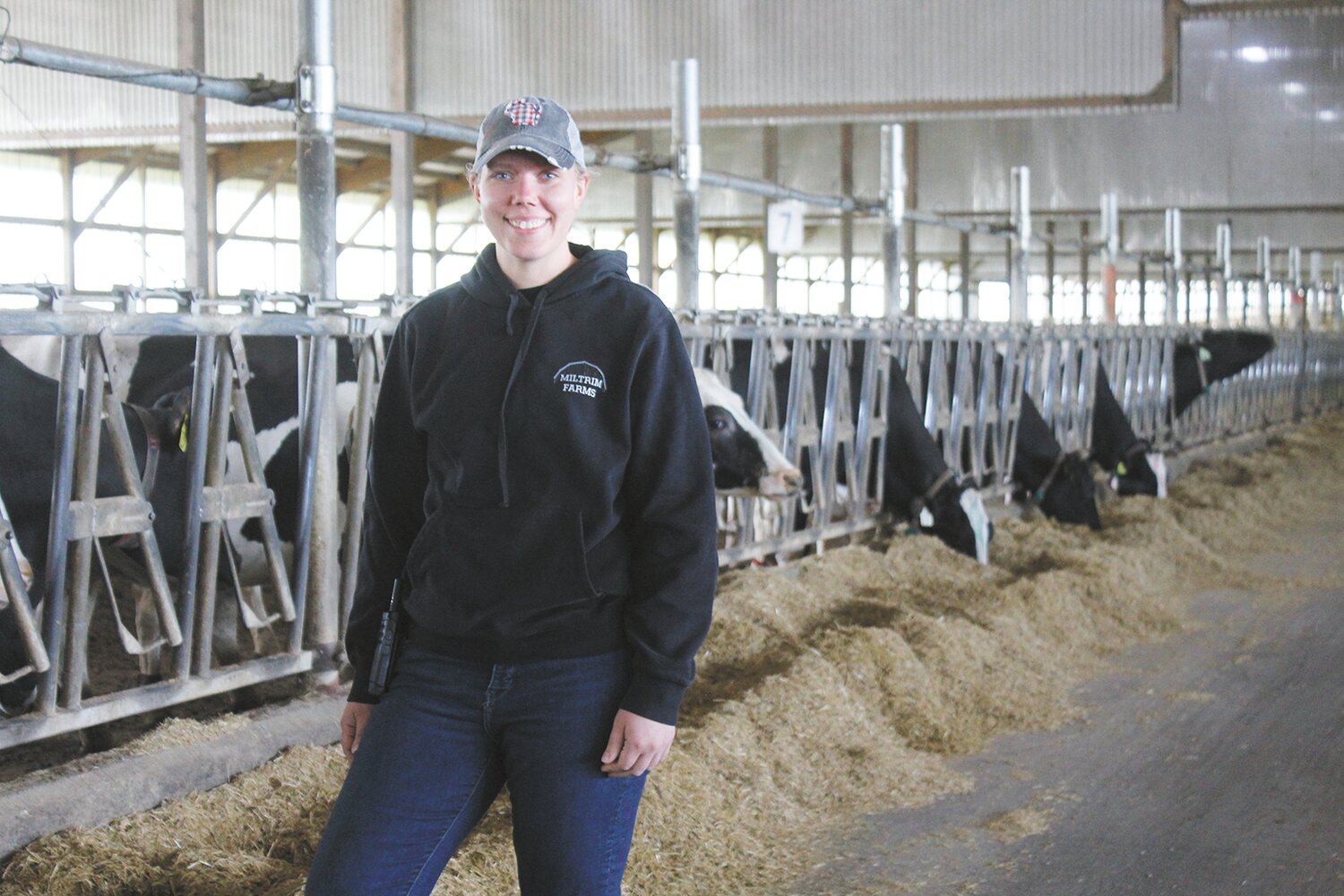
Danielle Warmka, the conventional barn herd manager, said the additional data provided by the system has become invaluable as her team has learned to use it.
“Our number one benefit that we see using the system is through our health metrics,” Warmka said. “We use it a lot in our fresh cow pen. Every morning we create a list of what cows should be looked at, any cows that alert as urgent.”
Warmka said her team was able to watch how the data changed as it became more honed in on the farm’s cows.
“We still walk our pens, but we were able to make the connections between what we were seeing and what the reports were telling us,” Warmka said. “I think that helped us begin to understand and trust what the system was giving us. It took a while to build up a baseline before we felt like it was reliable data that we could trust.”
Learning to interpret the various data thresholds and determining her team’s comfort level with those thresholds was part of the learning process, Warmka said.
“We had to learn where we were comfortable making the decision between a cow who potentially needed intervention, and a cow who would be able to work through an issue on her own,” she said.
Data is provided about activity and the time a cow spends eating and ruminating. A cow flags as urgent in the generated reports when she drops below a certain threshold for any of the three, being noted as either urgent, significant or gradual.
“The reports note a cow’s movement between the thresholds,” Warmka said. “We don’t typically see a lot of herd health events with gradual cases; we find those to be flags for lame cows. Sometimes they are good at masking lameness, so when you get there to look at her, you know to look further.”
Once those parameters were established, Warmka said delving into the data became one of the most interesting parts of her job.
“I like seeing exactly how much more a cow is eating today versus yesterday, how her activity changed,” Warmka said.
The CowScout Cloud system allows reports to be viewed in a variety of ways, which allows each member of her team to choose the way the data works best for them.
“I like looking at all the numbers,” Warmka said. “Some of the guys prefer having color charts; if it’s red, they know she is urgent, that something is wrong. It keeps it simple for everyone using the data, and that is important.”
With that simplicity, Warmka said the efficiency with which her team completes its tasks has improved.
“We are still walking the pens every day, people are out there observing the cows, but the custom-built reports help us save time,” Warmka said. “We know we’re looking for certain cows, and it takes out the worry of wondering if you’ve missed something.”
The reports are an accurate reflection of what Warmka’s team sees cow side, she said.
“We’ve been able to get our parameters narrowed down so that if a cow is on the report, there is probably something wrong with her,” Warmka said. “If I’m looking at her and she looks OK, I’ll look further. It might be something like indigestion. We can get a jump on that with supportive care before it becomes an issue.”
Heading off those small troubles before they become serious problems has been a benefit of the system, Warmka said.
“We have a lot fewer cows moving into our hospital pen for indigestion for that reason,” Warmka said. “I would say identifying lame cows more quickly is another. A lot of times, mildly lame cows get missed because they’re lying down when you’re walking the pens. If they’re on the list, you’ll get them up and investigate. We’re able to get those cows in to see the trimmer before things deteriorate.”
Monitoring dry cows through ration changes has given Warmka more insight into the challenges those cows might experience through ration changes.
“We’re able to help our cows through those transitions a little bit better,” Warmka said. “Taking the best care of them we can at that stage allows for better calf development, with healthier cows. We’ve also caught a few cases of mastitis in dry cows earlier, so we’re able to treat them quickly and avoid issues.”
As they have learned to interpret the data, Warmka said her staff now relies on the CowScout Cloud for breeding, with all cows being bred first service through a double ovsynch. Resynchronizations are done off activity-monitored heats.
“Instead of going out and watching for heats, we’re using the data from the system to make sure we’re breeding cows at the right time, during the highest window of conception,” Warmka said. “We’re having really good luck with conception and breeding from the data.”
Above all, Warmka said she appreciates the user-friendliness of the CowScout Cloud.
“In about 10 minutes, I can get the reports and know which ones are flagged to look at,” Warmka said. “I can check their cow cards to see their history and then we’re ready to go walk the pens.”
The CowScout Cloud has given Warmka and her team the tools they need to help answer questions and solve problems that might arise.
“If we see something happening repeatedly, it is easy to find the data that correlates and helps us solve those problems,” Warmka said. “There are lots of ways to use the data, once you learn to understand and trust it. It’s more than just feeling like there’s another set of eyes on your cows; you can’t see the information collected by the system just through observation.”
 |
 |
 |
 |
Share with others


Comments
No comments on this item Please log in to comment by clicking here