
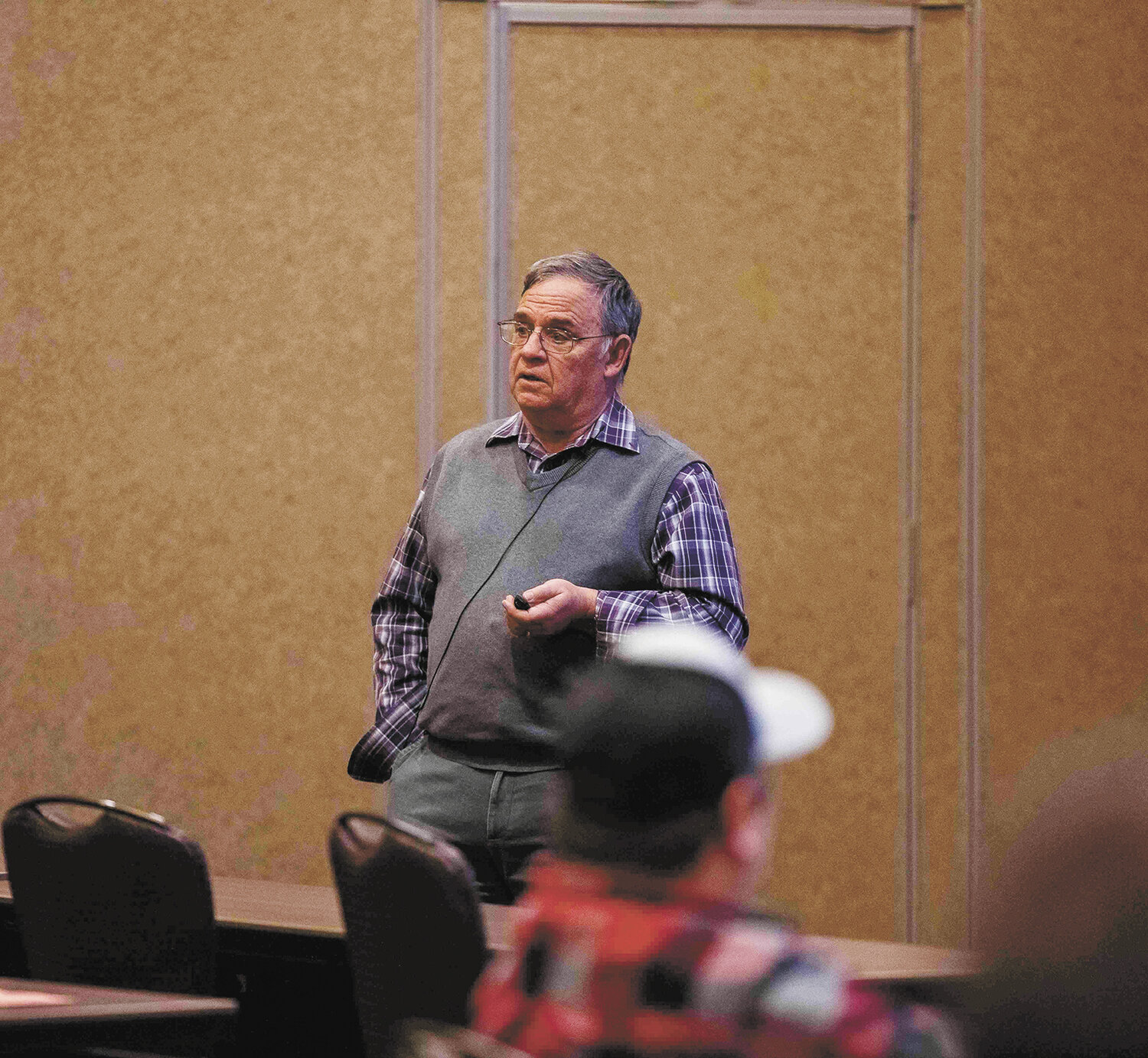
The way cows are fed is a building block that sets a foundation for a dairy’s success. Recently, the Professional Dairy Producers of Wisconsin hosted Dr. Joe Harner, an engineer with 40 years of experience with livestock and grain facilities at Kansas State University, as part of its Dairy Signal program for a presentation about feed center management.
Harner detailed feeding strategies that drive feeding efficiency: improving the timing of feeding, preventing feed waste, regular maintenance of equipment, and effective communication with dairy managers and feeders.
To improve efficiency, Harner said producers should think about feed centers as having four zones. In zone one, the only equipment is the loader used to fill a stationery or mobile feed mixer.
Zone two features space for ingredient delivery trucks and commodity bays. This should be set up in a way that trucks do not hinder the total mixed ration loader from accessing ingredients.
The third zone is primarily for the TMR mixer or feed delivery trucks. This allows for nonstop travel from the feed center to the feed bunks.
The final zone is the exterior access to the feed center. This area gives the ingredient delivery trucks the ability to move from scale to feed center without compromising biosecurity protocols.
With this setup, Harner has discovered that dairies can mix feed 25% faster on the weekends than Monday through Friday. This is due to the congestion that zones 1, 2 and 4 can have during the week because of heavier traffic from visitors and deliveries to the farm during the week compared to the weekend.
With a goal to average 12 tons of feed mixed per hour per employee, these zones create a more efficient feeding pattern. This equates to mixing a batch of feed every 30 minutes.
This would be based on an approximate timing of 10 minutes to load forages and grains, five minutes for liquids, five minutes for mixing and 10 minutes for delivery. This formula was for a batch with 4-6 ingredients per load, using pre- or batch-mixes to help with small inclusion ingredients.
The timing of his 30-minute goal is also predicated on having a limited amount of stops for the TMR mixer. All ingredients are located near the TMR with a maximum of 2-3 stops per load. If needing to move the TMR mixer, one stop should be near the commodity bays and another at forage locations to aid in efficiency.
Traffic patterns play a role in the efficiency of mixing as well. When possible, there should not be interference from other unloading trucks or equipment. Limiting the number of gates that need to be opened and closed and ensuring there is no cattle traffic can help improve the efficiency of feeding too.
Preventing feed shrinkage is a critical aspect of decreasing waste and improving efficiency. Harner said identifying the cost of the top 3-5 ingredients and setting a goal to reduce that ingredient’s purchase by 2-3% can cut costs significantly.
He also detailed the importance of identifying feeder problems versus facility problems.
Feeder problems consist of the time to perform a task, unloading of trucks, potential carelessness of employees and records utilization.
Facility problems were specified as rain, wind and solar radiation, excess purchases, co-mingling of ingredients, storage issues and mixer calibration.
Harner said most challenges are the result of having inadequate facilities to handle the volume of product moving through a feed center.
Harner discussed practices to limit co-mingling and waste. Recently, the construction of commodity bays has seen a normally 12- by 16-foot building nearly double in size, with most construction moving to a 24- by 30-foot design.
In the larger buildings, or when applicable to current commodity bays, deeper bays with higher walls have seen a decrease in wasted feed due to co-mingling. Commodity bays that are 40- by 50-feet deep with a wall height of 12-16 feet minimize overflow in adjacent bays.
The size and height of new commodity bay construction can vary by region. In some regions, ingredients are delivered with different style trucks, which plays a role in the construction of space. The specific delivery truck style can also limit availability and timeliness of delivery, or be an extra cost incurred by the dairy.
Harner said a simple way to reduce waste is with regular maintenance on equipment. In a 22-farm study by the Vita Plus Corporation, 50% of mixer scales were found to be inaccurate. The equipment was never calibrated and binding or load cells were not working properly.
Harner recommended consistent TMR system checks. The study revealed regular problems included TMR frames covered in debris, like mud and feed, support arms that were rusted or broken, shifts in frame mounts, or the mixer itself riding on the frame and not allowing load cells to work properly.
Harner said before setting sights on a new feed center to make sure the current one is running to its highest potential. This is a more cost-efficient way to improve feeding than investing in a new one. Harner said to start by taking care of equipment, ensuring load scales are accurate, cleaning areas and making sure everything works properly. All this can improve the current feed center.
Another solution Harner presented was focusing on people. Discussing with the feeders their importance to the operation, the importance of each ingredient and explaining which ingredients cost the most each day can help create a better understanding of the importance of efficiency.
Harner said understanding how feed affects milk production and herd health is a simple, yet effective strategy to improve feeding efficiency. Harner said he recommends dairy managers mix feed on the farm at least once a month. This lets the manager see what the feeders are experiencing. Then, the two can work cooperatively to identify where there is a lack of efficiency and discuss ways to improve.
 |
 |
 |
 |
Share with others


Comments
No comments on this item Please log in to comment by clicking here