
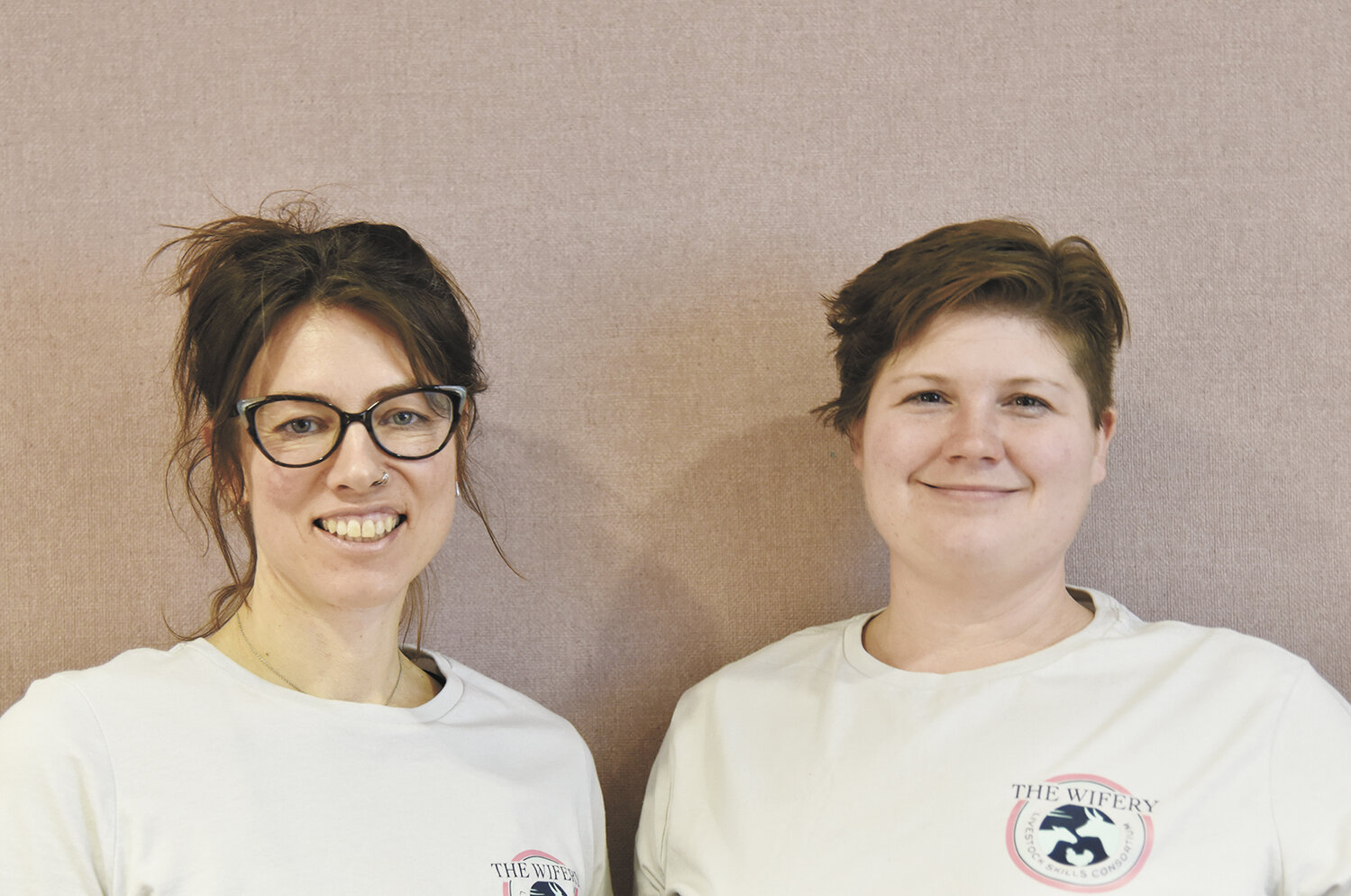
ST. CLOUD, Minn. — Animal health is one of the top priorities on dairy farms. Kari Ripley-Boysen and Lindsey Zemanek, members of the Wifery Livestock Skills Consortium, shared some of their knowledge about animal care at the 2025 Minnesota Organic Conference Jan. 9-10 at the St. Cloud River’s Edge Convention Center.
Ripley-Boysen has a degree in veterinary medicine and worked as a veterinary technician for a small animal vet. Zemanek also attended college for veterinary medicine before switching majors.
Ripley-Boysen has a hobby farm in southern Minnesota. She has Hohenberg goats, chickens and ducks. Zemanek also has a small hobby farm with mainly sheep but also horses, meat birds and rabbits.
Both women have shared and grown their knowledge for animal health through the Wifery Livestock Skills Consortium.
“We want to provide the skills at our workshops and the tools to give people the (option) to use their own skills,” Ripley-Boysen said.
Six women with vet skills and knowledge established the organization. Ripley-Boysen said the group was launched because many vets in their area were retiring, switching to small animals or no longer doing farm visits. Through the group, they share knowledge in the veterinary field with producers around Minnesota.
Their goal is to alleviate the stress of vets getting overwhelming calls by educating producers about what to look for and how to care for minor illnesses and parasites. Although the pair knows the most about small ruminant animals, many of their strategies can be utilized across other types of animals.
“I think some people have the mindset, if you have knowledge, you should kind of guard it because it gives you power,” Ripley-Boysen said. “(It’s the) exact opposite for us.”
In their presentation, the duo focused on anemia in livestock, what it is and how to check for it.
One way to check for anemia is with the FAMACHA system developed at the University of Pretoria, South Africa, to gauge anemia caused by the barber’s pole worm.
The FAMACHA chart has five different levels membrane color ranging from blood red to cream white. The deepest red is a sign of a healthy animal while white is severely anemic.
“If you’re looking at a three, particularly in goats you might think about what else is going on with that animal … (and) if you want to (address) it or not,” Ripley-Boysen said. “Four and five is where I would think about medicating with some sort of de-wormer.”
Even though FAMACHA originated in goat herds it works for most mammals they said.
A method to check on the color for anemia on the membranes around the eyes is the push, pull, pop method. It requires two hands. The first step is to push the eye of the animal in slightly, pull the lower lid down and the mucus membrane will partly pop out.
“Your first judgment call on what you see is what you’re going to gauge it on,” Ripley-Boysen said.
On animals not handled regularly or who do not like being touched, Zemanek said they found it easier to quickly pull down the eyelid and then look at the color of their gums or another indicator.
“If something’s wrong with that, you need to (know) what’s going on,” Zemanek said. “If you can get a look at the membranes, it tells you if you’re dealing with something that’s causing anemia. If it’s causing anemia, it can go fast.”
Many things can cause anemia, including feed rations, iron deficiency or parasites.
Each animal reacts differently to the different levels of anemia the pair said. Zemanek said they had a draft horse that was acting off and when checked, it was in the middle range. But with some of her sheep that were acting just a little strange, their membranes were white.
“I have some really thrifty sheep,” Zemanek said.
Even with the shared knowledge between the group, they all know they are still in need of vets in their area.
“We love our vets; we’re not trying to take the place of vets,” Ripley-Boysen said. “We want to be able to do as much as we can in the situations that we need to and (utilize) all of our tools in our tool belt.”
 |
 |
 |
 |
Share with others


Comments
No comments on this item Please log in to comment by clicking here