
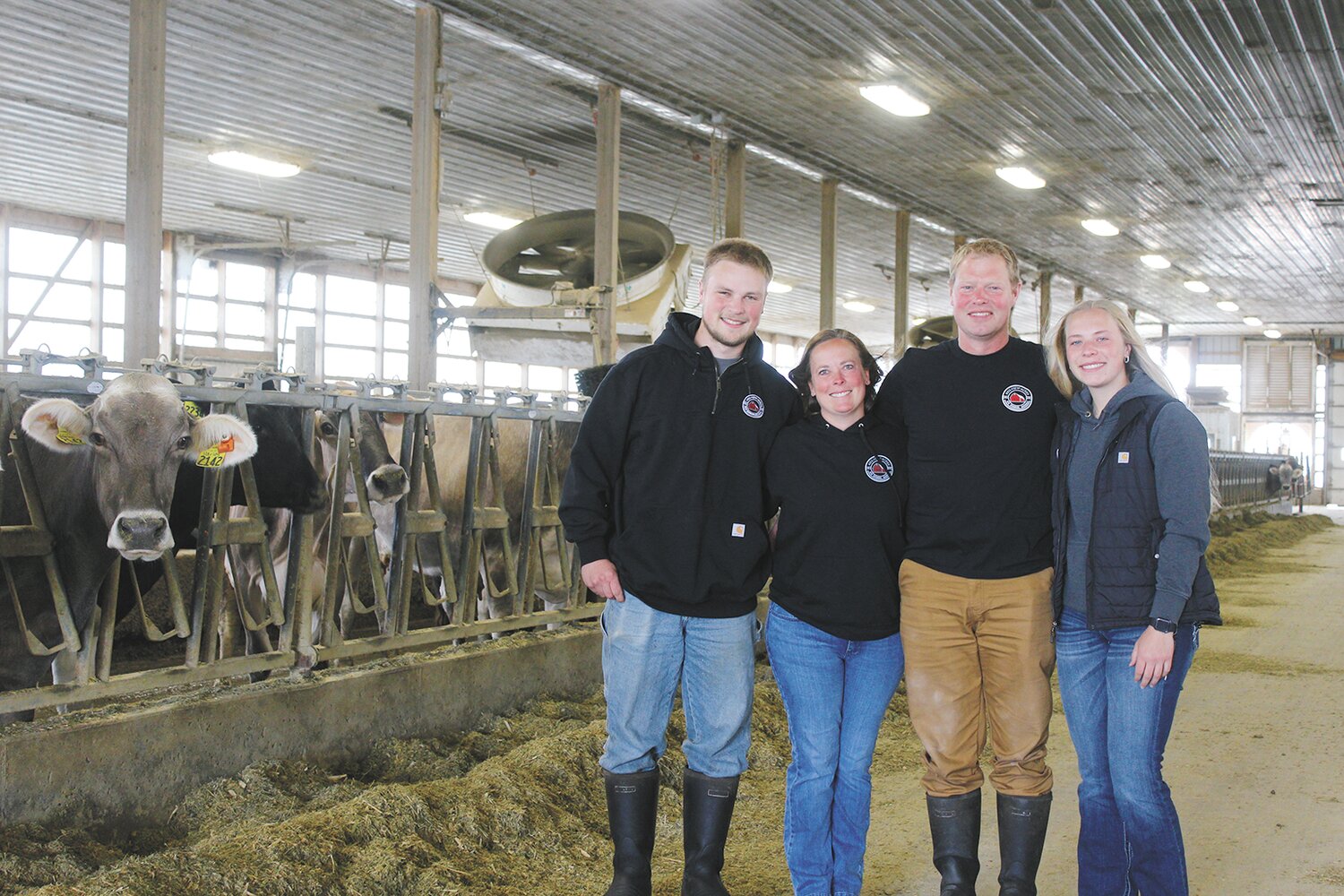


NEW RICHMOND, Wis. — The fourth and fifth generations of the Neumann family dairy farm together at Neu-View Acres continuing to nurture the passion for farming planted three and four generations ahead of them.
Bjorn and Jamie Neumann, and their son, Ben, and daughter, Gabbie, milk 200 cows using four DeLaval robotic milking units on their Polk County dairy farm near New Richmond. The herd is half Holstein and half Brown Swiss, a breed the family has developed an affinity for.
Farming 4,500 acres, the Neumanns grow feed for their herd and additional crops to market. In addition to working on the farm, Jamie holds an off-farm job. Bjorn’s brother, NAME, works with their farm’s cash-cropping division.
The current northwestern Wisconsin farm was established in 1953, when Bjorn’s grandparents, Clarence and Leona, moved the dairy after facing urban sprawl encroaching on their second-generation farm on the outskirts of St. Paul, Minnesota.
Bjorn’s parents, Roger and Laurie, became the third generation of the Neumann family to enter the profession of farming after their marriage in 1975. In 1999, after Bjorn and Jamie married, they became the fourth generation to set roots on the family farm. Ben came home to join the farm as the fifth generation after graduating from Chippewa Valley Technical College, while Gabbie hopes to stay close to the farm after completing her degree at Iowa State University.
Family is the foundation on which their farm was built, Bjorn said.
“The benefit of working with family is knowing you can rely on them, they’ll always be there,” Bjorn said. “The few people we have hired have been very good, but there is just something different about family — they have that commitment to the farm.”
For years, the Neumann family milked a herd of 80 cows in a stanchion barn, while farming around 1,200 acres of land. In 2016, they built their freestall barn and grew the herd size, while continuing to use the stanchion barn as a parlor.
“Growing up, my parents, grandparents, brother, sister and I always did all the work on the farm,” Bjorn said. “We never hired anyone. Then my dad passed away in 2018, and it was just my mom and me doing the milking and all the chores. It got to be a little too much, so we hired someone to get us through.”
The labor shift prompted the Neumanns to evaluate their farm, and robotic milking entered the discussion.
“With our labor needs changing and knowing that Ben wanted to return to the farm after college, we decided robots were the way to go,” Bjorn said.
In 2022, the Neumanns began their new way of dairy farming.
“Taking that leap was stressful,” Bjorn said. “Our herd was older, and you would hear older cows typically had a harder time adapting. Advanced Dairy said they had never started a Swiss herd before, and they were a little nervous (about) how those cows would adapt. You start to think of everything you have invested; what if it doesn’t work?”
The cows transitioned to their new lifestyle seamlessly, but Bjorn said he struggles to give the cows autonomy.
“I still feel like I need to be in there checking on them, making sure all four quarters are being milked,” Bjorn said. “If one is incomplete, I feel like I need to get her, while they say she’ll come back around herself and will be fine. If I’m here doing chores by myself, I made sure the list has zero overdue cows and zero incompletes, because then I know every cow is milked.”
Jamie said relying on the robots were the hardest part of the change for Bjorn.
“He’s used to touching the cows twice a day,” she said. “Now he’s just checking in on them.”
The Neumanns have witnessed positive changes in their cows over the past three years.
“They are much calmer; the barn is so quiet,” Bjorn said. “Production and components both went up and our cell count dropped substantially going into the robots.”
The herd is averaging 80 pounds of energy-corrected milk with 4.4% butterfat and 3.7% protein, while making 3.2 visits to the robots per day. The Neumanns utilize CowManager and breed their cows using natural heats detected by the monitoring system.
The cows are an acquired taste for him, Bjorn said.
“They were never really my forte growing up,” Bjorn said. “My dad, brother and I always said once we reached 5,000 acres, we could sell the cows and just focus on crop farming. Then I got married and Jamie liked the cows, especially the brown ones. My sister had grown up showing Brown Swiss, and I didn’t like them — they were always the princess cows. Then Ben got to liking the brown cows. All of the sudden, everyone liked the cows, so I figured we might as well keep them, and see if he wanted to do this when he grew up.”
Ben’s affinity for the Brown Swiss has parled into an interest in genetics and developing cow families. He handles most of the breeding on the farm. He strives to continue to improve the herd, making corrective mating decisions, focusing on longevity while increasing production and components and maintaining sound, functional type.
Bjorn’s father became interested in breeding polled cattle in the late 1970s and the Neumanns estimate nearly 70% of the herd is now polled. Ben has continued using polled genetics. One of their goals is to put a polled Brown Swiss bull into A.I.
The results of Ben’s mating decisions are visible Gabbie said.
“The fun is being able to see how you can change them, making them better from generation to generation,” she said.
As the fifth generation continues to become invested in the family’s legacy, the family’s goals are focused on improvement over expansion, with their sweet spot set around 220 cows.
“We’re not planning to add on or grow for now,” Bjorn said. “If there is any expanding to be done, that will be for the next generation to decide.”
 |
 |
 |
 |
Share with others


Comments
No comments on this item Please log in to comment by clicking here