
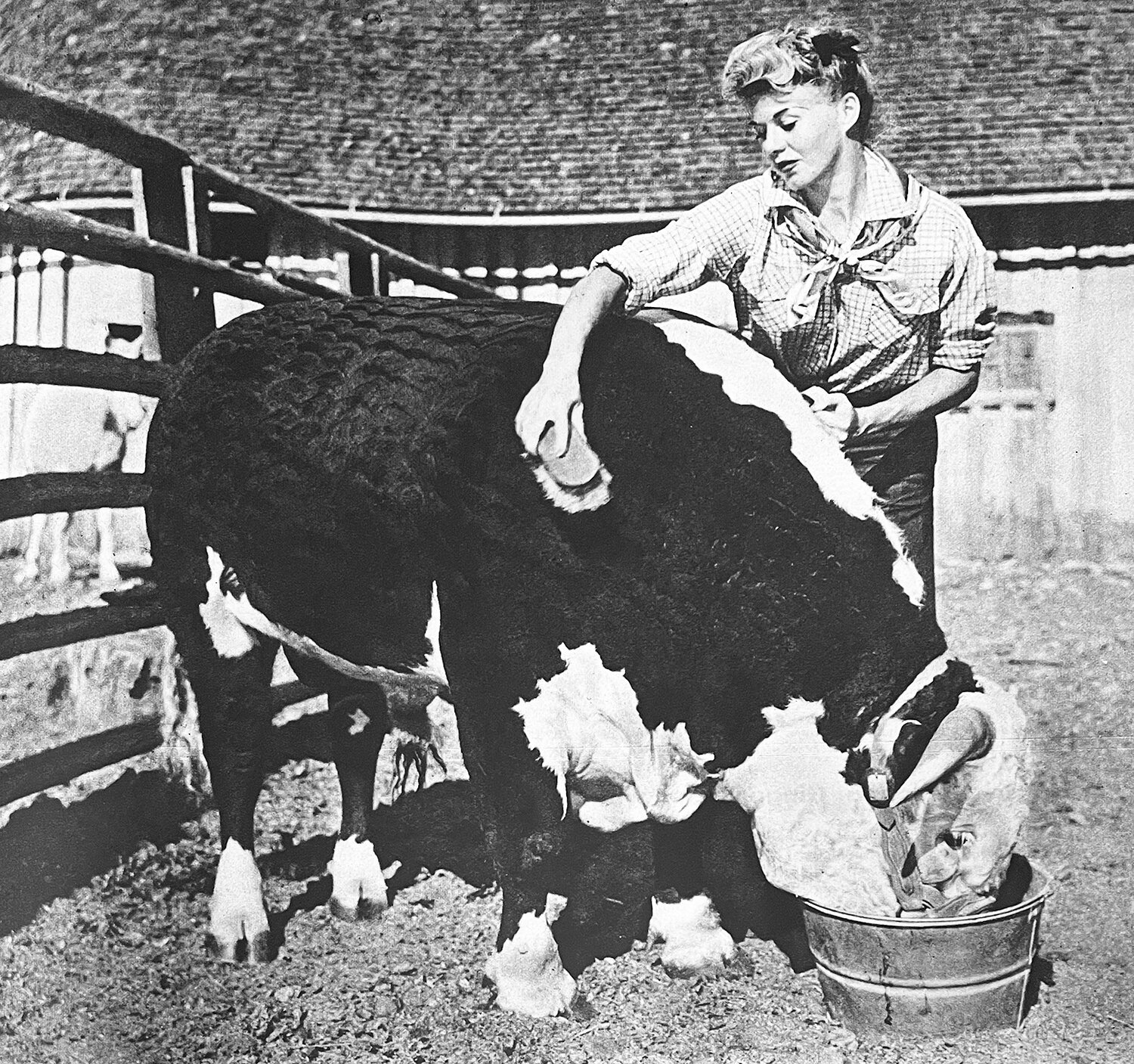


EAGLE POINT, Ore. — While she might be best known for doing everything Fred Astaire did, backwards and in high heels, there was much more to Ginger Rogers than Hollywood glitz and glamour. Rogers felt most at home on the Oregon ranch she owned and occupied with her mother, Lela Rogers.
Rogers’ Rogue River Ranch, frequently referred to as the 4R, was located near the hamlet of Eagle Point, 17 miles north of the city of Medford. The mother-daughter duo purchased the 850-acre ranch in 1941. The purchase was made by combining two parcels: a 470-acre tract on the east side of the Rogue River, and a second, 380-acre tract, on the river’s west bank.
The elder Rogers adamantly told the press at the time of purchase that the ranch was viewed as an investment, not as a playground for the Hollywood starlet. Lela explained plans were being made to develop a herd of purebred Angus cattle on the east side of the river while turning the acreage on the west side into an ultra-modern dairy farm.
“We will have possibly 50 dairy cows and as many blooded cattle as the ranch will accommodate,” Lela told the Medford Mail Tribune in 1941.
She also said they planned to have the ranch completely stocked within two years.
In 1942, two additional land parcels were purchased, bringing Rogers’ land holdings in Oregon to a total of 1,050 acres, with more than 2.5 miles of river frontage on both sides of the river.
Ginger’s intent for her ranch to be considered a serious venture was met with jibes from others.
In the Medford Mail Tribune, it was reported that Dr. W. H. Lytle of the Oregon State Department of Agriculture suggested to actor and eastern Oregon rancher Eugene Pallette that he should be sure to tell Miss Rogers to register her livestock brand. Pallette’s response to Lytle was that Rogers’ livestock would probably consist of nothing but bees.
Lela wrote back to the state agriculture department, holding fast to her daughter’s insistence on establishing her ranch with both purebred dairy and blooded beef cattle. She wrote that her daughter had decided on using “4R” as the brand for some Golden Guernsey cattle that Ginger had already purchased. The star applied for membership in the American Guernsey Cattle Club in 1942.
The dairy on the farm, modern by the standards of the time, was home to a herd of 32 Guernsey cows. The nucleus of the herd was purchased from breeders in Skagit County, Washington. The milk was primarily supplied to more than 2,000 soldiers at nearby Camp White during World War II at the rate of 150 gallons per day.
The cows were milked in a 12-cow parlor and kept a low bacteria count for raw milk. The cows were fed in a 40-cow feeding barn. An 8-stall hospital barn was made to care for special needs cows. A silo was built to store 150 tons of corn silage, and the farm was home to a hay-keeper with the capacity to store 100 tons of haylage.
When asked by reporters if she expected the ranch to pay, Ginger was quick to answer.
“You’re joking, aren’t you? Why, darn it, I am making it pay,” Ginger Rogers said in an interview printed in the Medford Mail Tribune. “That ranch is no hobby with me. I have enough hobbies. It’s my insurance, and when I’m through in films, I’m going up there to live. I spend all the time I can there now.”
When she was on the ranch between films, Rogers would help with chores, although she admitted she kept them light — no plowing or hoeing. She did not milk by hand; the farm had electrical milkers.
The womens’ aspirations of building the herds on their ranch struggled due to labor shortages. Ginger sold a number of animals from the herd and entered profit sharing with a partner to make the ranch work. The Guernsey herd was sold around 1943.
In 1948, Ginger began restocking the farm with cattle in hopes of reopening the dairy on the ranch. In 1959, a portion of the ranch was listed for sale. Ginger held on to most of the estate until 1990, when she sold the remaining land. She continued to keep a home in Medford until her death in 1995.
The ranch played a vital role in Ginger’s life, she told writer Jack Holland in an interview.
“I honestly think that of all my material possessions, the ranch is my biggest thrill,” Ginger said. “To own one had always been a secret desire of mine, yet I never told a soul about it. Perhaps because I didn’t want to listen to a lot of idle talk and advice as to why I would be foolish to buy a ranch.”
Sources-
Medford Mail Tribune (Oregon)
Guernsey Breeders’ Journal
LOOK Magazine
LIFE Magazine
Western Livestock Journal
 |
 |
 |
 |
Share with others


Comments
No comments on this item Please log in to comment by clicking here