
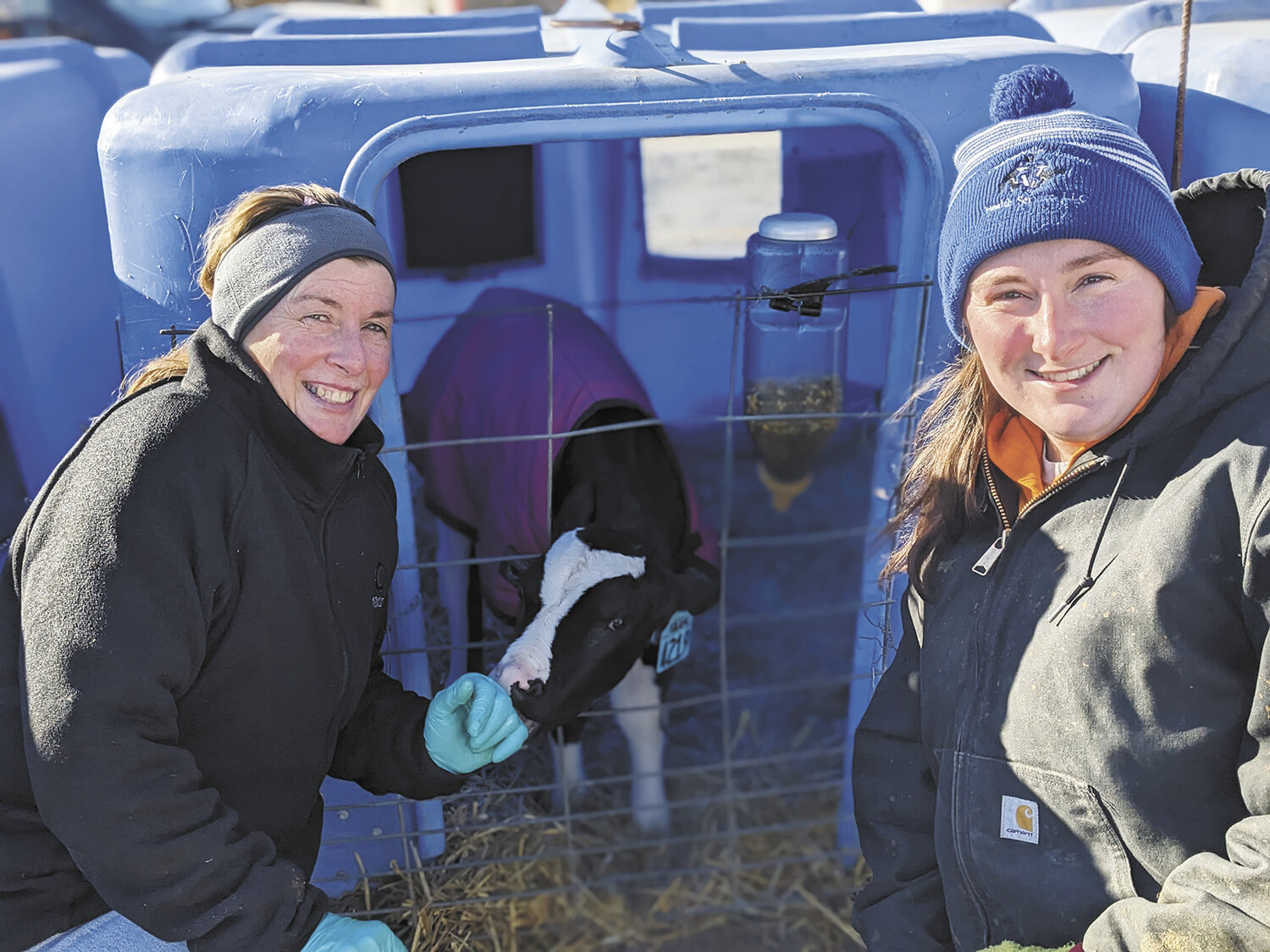


GERMAN VALLEY, Ill. — When Brooklynn Hollis returned to the family farm in 2022 after graduating from the University of Wisconsin-Platteville, she took over breeding decisions in her role as herd manager and pursued 100% polled genetics. Today, 60% of the farm’s youngstock are polled.
“Dehorning is a stressor we want to avoid,” Brooklynn said. “Not having horns reduces stress on young calves.”
Brooklynn is the fifth generation at Jo-Eng Dairy Farms Inc. where she farms with her parents, Jodi and Todd Hollis, her grandparents, Gary and Sally Engbert, and her uncle, Michael Engbert. Michael’s wife, Cindy, works off the farm.
The family milks 720 cows and farms 1,300 acres near German Valley. Cows are milked three times a day in a double-16 parallel parlor. Jodi said they have worked hard to increase butterfat and protein over the last few years, with an emphasis on fat. The farm’s rolling herd average is 30,777 pounds of milk with 4.0% butterfat and 3.0% protein.
“We don’t focus on high milk bulls,” Brooklynn said. “Components, daughter pregnancy rate and reproductive performance are most important to us. In this area, you get paid more for butterfat and protein. We also strive for longevity.”
The farm is home to many 9-, 10-, and 11-year-old cows, and 53% of the herd is in their third lactation or later.
Brooklynn’s polled genetics breeding strategy was motivated by a desire to eliminate dehorning on their farm, which she said is made more labor-intensive using pain medications. Using nerve blocks to manage pain, the family has dehorned calves as young as 1-3 days of age.
“We’ve always used paste for dehorning, but it’s not 100% effective,” Jodi said. “If the dehorning process didn’t take right, you can have animals with one horn later on or curved horns.”
Dehorning now takes place once a week versus several times a week, given the reduced number of calves born with horns.
Jodi said they dabbled in polled breeding for quite some time before adopting the exclusive use of polled genetics.
“We thought, ‘What good is it to just breed a few polled animals in a herd our size,’” Jodi said. “‘It’s not going to make a big difference. We have to be all in or all out.’ So we went all in. You have to be that way for a few years before you see the difference.”
Polled bulls are used for all sexed semen breeding on the farm. Brooklynn concentrates on elite, up-and-coming polled sires. Jo-Eng Dairy Farms is part of Select Sires Inc.’s NxGEN program and ABS Global Inc.’s Icon Sires program, both of which give the farm access to the most elite genetics at each cooperative.
“There’s not a whole lot of polled bulls, but when there is, they are top-notch,” Brooklynn said. “We’ll use bulls that are not on the program too. The gap between the best polled bulls and the best horned bulls is shrinking.”
Jodi agreed.
“They’ve come a long way on polled genetics in the last few years,” she said. “There are getting to be more and more polled bulls to choose from, and there are more homozygous polled bulls, which you know will give you polled calves.”
A homozygous polled animal, identified as PP, has two copies of the polled gene and does not have horns, nor will any of its offspring have horns. The polled gene is dominant, therefore, if a calf is a polled carrier or heterozygous Pp, she will not have horns, but she could have offspring with horns. When a homozygous polled animal is bred to a homozygous horned animal, there is a 100% chance of getting a polled calf. Thus far, one homozygous polled calf has been born at Jo-Eng Dairy Farms.
“We hope to build up our population of homozygous cattle,” Brooklynn said.
If a polled carrier is bred to a bull with horns, there is a 75% chance she will have a calf with horns, Brooklynn said. A mating of two heterozygous polled animals results in a 25% chance of producing a calf with horns. When breeding a horned cow to a polled bull, there is a 50% chance of getting a calf with horns.
“It will take a long time to get to a herd that is 100% polled, if that is even possible,” Jodi said.
Once they attain multiple homozygous animals within the same family, Brooklynn said they plan to breed back to a horned bull for genetic purposes, which will still produce a polled calf.
“A lot of the top genomic polled bulls stem back to the same bull, so this helps us diversify and avoid inbreeding,” she said. “Breeding decisions get complicated with homozygous and heterozygous animals.”
Brooklynn uses polled Holstein, Brown Swiss and Jersey bulls along with Angus semen on the predominantly Holstein herd that also includes Jerseys and Brown Swiss. The only cows bred to horned dairy bulls are Brooklynn’s Ayrshire show cows.
At Jo-Eng, 25%-30% of cows are bred to sexed polled dairy semen, and about 75% are bred to beef semen. They breed 80% of heifers to sexed polled dairy semen and 20% to beef semen. Brooklynn said their reproduction rates are high, with a pregnancy rate of 37% and a conception rate of 47%.
Brooklynn handpicks 6-8 polled bulls to use at once and rotates bulls periodically. One of her favorites they have used heavily is Penn-England Chew-P-ET.
“Proofs come out every quarter, and we’re always watching if there are younger, newer bulls we could be using,” she said. “Everything is mated through Select Sires based on genomics, which helps with inbreeding levels.”
Brooklynn tries to incorporate at least one Red & White bull.
“There are very few Red & White polled bulls,” she said. “Brown Swiss also has a small selection of polled bulls.”
As they work to build a herd of polled cattle, Brooklynn said she is looking forward to developing high genomic polled animals to potentially in vitro fertilize. The family does genomic testing on all heifers, and while genetic progress has not grown as quickly in the last couple of years, Jodi said they are still above the baseline.
“We take a dip in genomics doing this, but we feel the advantages are going to outweigh the disadvantages,” she said.
The first polled heifers born since starting the program will enter the milking string in the next few months, and Jodi said she does not feel this sacrifice in genomics will impair production.
“I’ve always believed that if we take good care of our cows, they’re going to take care of us and produce milk,” Jodi said. “We have older cows with older genetics, and they milk well, so these polled ones can do it too.”
 |
 |
 |
 |
Share with others


Comments
No comments on this item Please log in to comment by clicking here