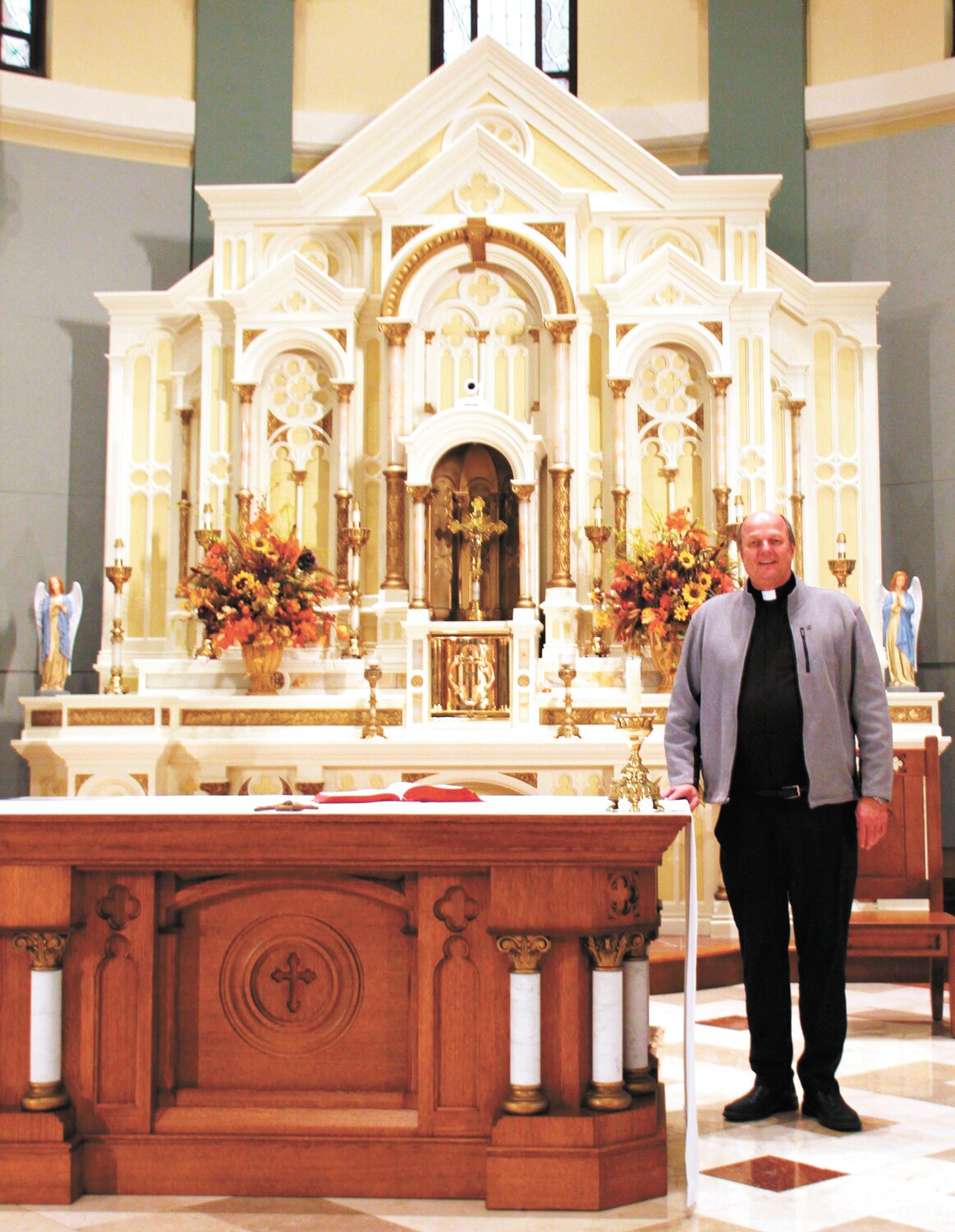


MARSHALL, Minn. — Fr. Steve Verhelst spent his childhood working in the dairy barn. Now, he has traded the barn for the church, presiding over four parishes that are part of the Mary, Mother of God Area Faith Community in Marshall.
The youngest of 10 children, he grew up on a dairy farm with his parents and siblings near Canby. The Verhelsts milked 80 cows in a 12-cow stanchion barn.
“It was very simple, in the sense that there wasn’t a whole lot of technology,” Verhelst said. “We would bring 12 cows in at a time, feed them, milk them, let those cows out, then bring 12 more cows in.”
Vershelst has been a priest for 35 years and has presided over area faith communities near Benson and Wilmar before coming to Marshall.
Verhelst said he credits growing up on the dairy farm for teaching him the value of hard work and commitment.
“It is a calling to be able to be a dairy farmer, or a farmer in general, in the sense that it makes demands of you that you probably weren’t aware of when first attracted to it,” he said. “The cows depend on you 365 days a year, there is no observation of holidays or vacations for them.”
Verhelst said he recognizes what an incredible gift, privilege and honor it was to grow up learning the value of hard work and working together as a family.
“My grandmother always taught us: the grass may not be greener on the other side of the fence, but you can be assured, the grass is always going to be greenest wherever you choose to water it,” Verhelst said.
Verhelst’s dairy farm was started as a wedding gift to his parents from his maternal grandmother.
“We have our mother to thank for being in the dairy business,” Verhelst said. “Having 10 children in 11 years, no twins, my mother was busy having children and raising them. She would always bring the infants with her into the dairy barn and put us in a little crib, and we played while she milked the cows.”
Verhelst said one lesson that his father instilled in the children was that the work is never done until everyone is done.
“My father was trying to teach us as youngsters that you might have your particular chore done, but if your siblings are still working on their chores, then you need to help them,” he said. “It has been a valuable lesson that has helped me throughout my priesthood as well.”
Chores were divided based on age. Chicken chores were for the young children. Around the age of 8 is when Verhelst started with calf chores, then in his early teens, he transitioned into milking cows with one of his brothers, while the older siblings helped their father with field work.
The Verhelsts used Surge canisters to collect the milk. After each cow was milked, they carried each canister to the milk cooler to be strained twice.
“It was usually between two and a half to three hours every morning and every evening to milk cows with the two of us working together,” Verhelst said. “While milking cows, WCCO, an AM channel, was always on our transistor radio. One day I was milking by myself, I switched the radio to an FM rock and roll station. I enjoyed the music, but the cows did not. They were uncooperative, kicking the milkers off and not milking out.”
Verhelst said he remembers his father switching the radio back to WCCO, and the cows calmed down and milked out without any issues.
“I share this lesson in one of my homilies,” Verhelst said. “Even cows recognize a familiar sound and respond accordingly. We should be reminded to listen to those voices of stability and continuity in our lives that we need. Hopefully, one of those voices is the voice of our Lord.”
Verhelst first considered seminary after being an altar server in junior high.
“The priest asked me if I ever considered being a priest,” he said. “I thought about it a little bit at that time. I was still pretty young, and I didn’t give it much attention.”
Towards the end of his senior year of high school, Verhelst was called to the assistant principal’s office.
“I was scared to death of what I had done, but I didn’t remember that I had done anything,” Verhelst said. “He called me to his office so I wouldn’t feel left out. After visiting with him about future plans, he asked if I had ever thought about being a priest. He acknowledged I was somebody who was always eager to help others and was sensitive to the needs of people around me.”
While attending the University of St. Thomas, Minnesota in St. Paul, Verhelst said seminary was his path. After graduating from college, he entered Saint Paul Seminary, which was across the street from the college, and was ordained in 1990.
Verhelst said he said he has been fortunate to be relatively close to home over his years as a priest. While he is thankful to his home parish priest and assistant principal, he is mostly thankful to his family.
“Through the decades, it has been my family who have really been my biggest supporters, champions and cheerleaders,” Verhelst said. “It’s interesting how life takes us full circle. I am able to visit my mother, brothers and nephews quite frequently.”
Verhelst’s family is no longer milking, but they raise heifers for large dairies.
His nephews have transitioned into ownership and often ask for his help, but just with the basics, Verhelst said, as he would probably cost them more money by breaking the equipment.
“I did not grow up with all the technology in the equipment,” he said.
As Verhelst looks ahead in life, he plans to continue serving the parishioners God has given him.
“I love being a priest, so I don’t ever see myself completely retiring,” Verhelst said. “However, I am looking forward to being a senior associate where I can celebrate the sacraments without the administrative duties of overseeing multiple parishes.”
 |
 |
 |
 |
Share with others


Comments
No comments on this item Please log in to comment by clicking here