
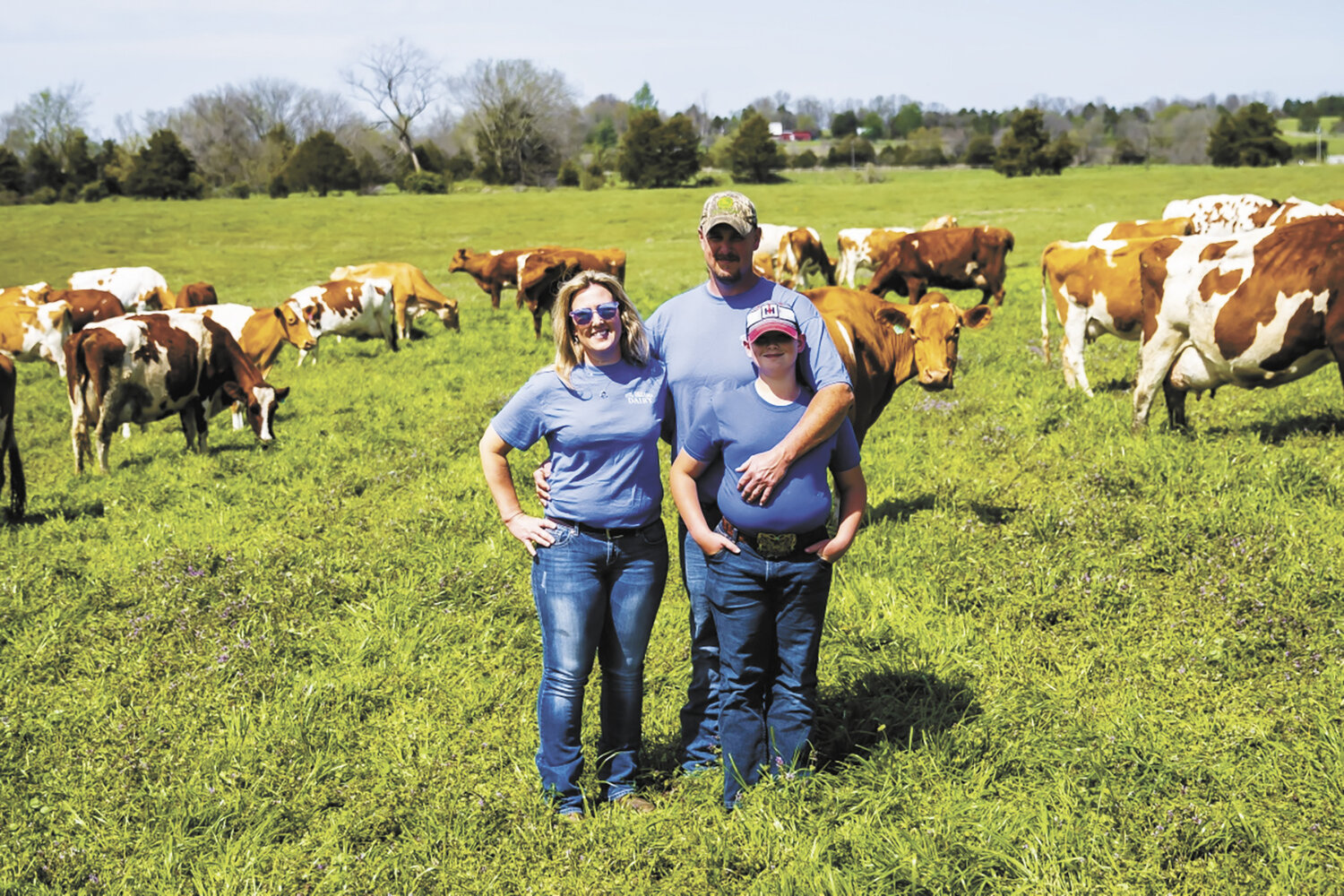


CONWAY, Mo. — Armed with the belief that the milk from their herd of Ayrshires and Guernseys is special, Brett and Jessica Dixon have long dreamed of directly marketing their version of liquid gold to consumers in the communities near their southwestern Missouri dairy farm, nestled in the foothills of the Ozarks.
The Dixons’ dream has slowly become reality, beginning with a Dairy Business Innovation grant they received in 2022, which allowed them to begin laying the groundwork for their on-farm creamery that became operational in October.
“Direct marketing was always a goal,” Jessica Dixon said. “We were at a point where we figured we needed to quit dreamng and either needed to do it or not. We took a chance and applied for the grant. If we got it, we were going to power forward and make it happen. That was the turning point.”
Making that happen is nothing new for Brett and Jessica — fifth- and third-generation dairy farmers, respectively. They struck off from their established family farms in 2011 to begin building their own farm — Stil Dreamn Dairy near Conway. Today, with their son, Diesel, they milk 70 registered Guernseys and Ayrshires in a double-4 parlor.
In 2022, Brett’s sister, Katie Dixon, brought her Dix-Lee Guernseys herd to the farm to join the operation. The milking herds are housed at the Stil Dreamn farm in Conway, while dry cows and youngstock are housed at the Dix-Lee Farm, 14 miles away near Phillipsburg.
The milking herd is grazed on 135 acres on the Conway farm much of the year, Dixon said. The cows have access to a freestall barn during extreme weather but are typically outside most of the time. Forages are harvested on 200 acres at the Phillipsburg farm.
“Grazing is a constant challenge in Missouri because it gets pretty dry during the summer months and we have to supplement pasture with baleage then,” Dixon said. “Our grazing season typically starts in mid-March and then it picks back up in the fall.”
While primarily fed a forage-based diet, Dixon said the cows are offered supplemental grain in the parlor at milking time.
Dixon said the herd had included Holsteins, which she had grown up with, until 2018.
“Grazing was one of the big pushes behind going fully into colored cows,” Dixon said. “They tolerate our Missouri weather better than the Holsteins, so we went that route.”
The Guernseys and Ayrshires fit well into their plans of direct marketing their own milk, too, Dixon said.
“We’ve always thought our girls had a lot of things to offer,” Dixon said. “They’re primarily grassfed, A2A2, and being Guernseys and Ayrshires, their milk has a unique profile.”
Ayrshire milk has a naturally sweet taste Dixon said, and the fat globules in Ayrshire milk are small, making the milk more digestible and ideal for cheesemaking. Paired with the thick, creamy texture of the milk produced by their Guernsey herd mates, Dixon believes the milk produced on their farm has a lot to offer.
The road to capping the first bottle of milk has been a bumpy one, Dixon said.
“It’s taken way longer to get to this point than it should have — you name it, there’s been a delay,” Dixon said. “I had a grant get frozen early, even before Trump was in office, that delayed the building process. Weather delayed getting concrete poured, then our contractor had family and health issues.”
Working with a nearby cheesemaker, the Dixons began making cheese from milk produced on their farm, working towards their direct-marketing dream. The Dixons were also able to begin selling raw milk in their on-farm store prior to the completion of their creamery. Dixon still offers raw milk as an option.
Nearly three years after the initial grant was awarded and a year after they began construction, the Dixons’ dream began to flourish in earnest when their on-farm creamery became operational in late October. Along with bottling their milk, Dixon is currently making cheese curds in the new creamery. Block cheese will continue to be made off the farm.
“Right now it’s kind of chaotic,” Dixon said. “We’re up to 12 stores retailing our milk, along with our on-farm store, adding more every week. Right now, I have so many new stores coming on that want a small amount to start, which is fine. I’m happy to run them five or six bottles to start. Then they’ll call three days later and tell me they’re out and they’ll double that order, so that’s been really awesome.”
Public interest in locally produced food has played a role in the Dixons’ early successes, Dixon said.
Dixon said her family is also grateful their milk cooperative, has encouraged them in their on-farm processing journey.
“They’ve been very willing to work with us and understanding of us diving in and trying to make our lives better,” Dixon said. “We’ve been very open with them, communicating what our plans have been.”
Adjusting to the additional workload created by the creamery has been a challenge, Dixon said.
“It’s just the three of us — my husband, my sister-in-law and me — doing everything,” Dixon said. “There’s a lot to do and now a lot of my time is spent in the creamery and making deliveries. My son told me I should just stop sleeping so I would have more time.”
As an extension of the on-farm store and creamery, Dixon is interested in developing agritourism events to help create interest and drive traffic to the on-farm store. One event that has proven successful is inviting consumers to join the family as the cows are turned out on pasture for the first time each year.
“It’s always fun to watch the cows run and play the first day on pasture,” Dixon said. “We all enjoy watching that as dairy farmers, but we’ve learned the public enjoys it too.”
With the successes they have realized early in their direct-marketing efforts, the Dixons continue to keep one eye focused on the future.
“On-farm processing and direct marketing is how we hope to make our farm work to move into the future,” Dixon said. “We don’t want to have to expand — we’d like to get smaller, down to 50 or 60 cows and be able to process all our own milk. We’re always thinking about the future in terms of our son coming into the farm and taking over, with things like robots and facility improvements being part of those thoughts.”
 |
 |
 |
 |
Share with others


Comments
No comments on this item Please log in to comment by clicking here