
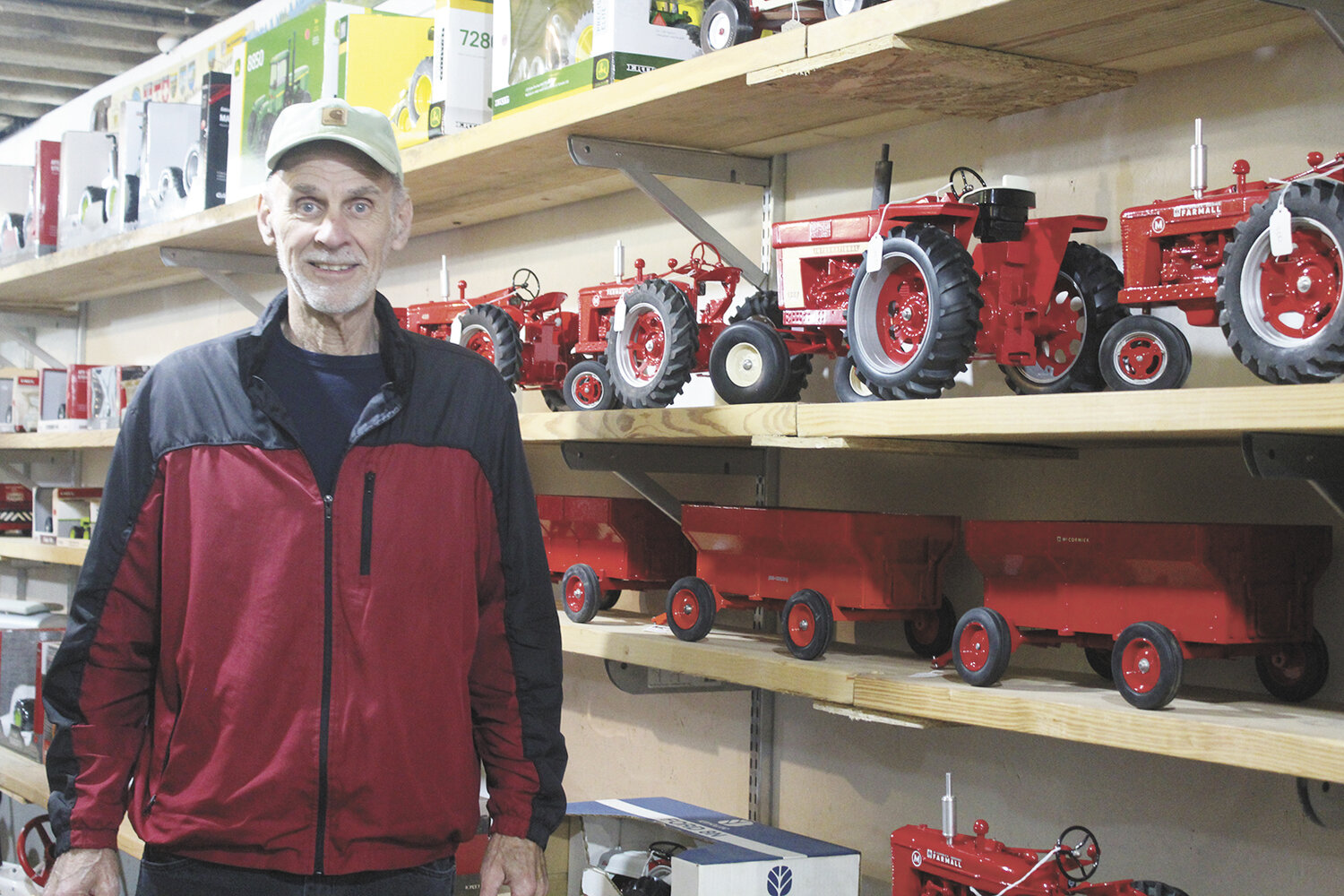


Vintage farm toys hold a special kind of nostalgia for many who grew up on family farms, cultivating dreams of continuing a family heritage.
The memories that sit on the shelf alongside the tangible vehicles are the primary driver for those who pursue miniature pieces of their past.
“People collect farm toys because they have the real stuff,” said Don Steiner, owner of Marv’s Farm Toys in Monroe, Wisconsin. “You ought to hear all the stories — ‘I’ve got such and such tractor;’ ‘My grandpa bought one of them when he started farming, so I have to have one.’ That’s 99% of it. Farmers come in and want something specific, something they had on the farm or grew up with. That’s the gateway.”
Collecting those toys of days gone by is a sentimental journey for dairy farmer Mark Hoesly, who milks 40 cows near Ladysmith, Wisconsin.
“I have pictures showing me playing with tractors and wagons when I was maybe two years old,” Hoesly said. “I don’t have those first toys I played with anymore, but I started collecting tractors when I was around 10 or 12. I liked all kinds, and I still do, but I’m focused on Fords, since that was my grandpa’s primary brand. He went from horses to Farmalls to Fords, so I’ll eventually add more red into my collection.”
Steiner said collecting is a generational pursuit in his family. He started collecting over 30 years ago, well before he began working for Marvin Rufi, the previous owner of Marv’s Farm Toys, who died in 2023.
“My house is full of stuff,” Steiner said. “I have three sons. They all farm and they all collect; my grandkids collect. I’ve been doing farm toys all my life.”
Steiner said he was involved in creating an annual toy show held at the school in Monroe. The show has not been held since before the pandemic, but plans are in the works to resurrect the event in August in a new location.
Toy shows and shops are a common place for collectors to find their pieces.
“I don’t spend a lot of time searching,” Hoesly said. “Occasionally I’ll do a search on Facebook Marketplace or Craigslist. There are some Facebook farm toy pages, but the competition there, either bidding or speed, makes it hard to buy on those. When I get to a tractor show, I’ll look at what the vendors have —those are typically the most productive to find what I’m looking for.”
Like the full-size models, toy tractors have evolved. Before World War II, farm toys were typically made of either dense cast iron or a much lighter version of lithographed tin. As the decades marched on, materials changed to include aluminum models and eventually plastic as well.
To keep proportions, tractors have been scaled down to size, with 1/16 and 1/64 scale models being the most common in the U.S. In a 1/16 scale model, each inch of the model represents 16 inches of the actual implement, so the size of the replica depends on the equipment it is modeled after.
“The 16-scales are the most common that I see people looking for,” Steiner said.
As a nostalgia-inspired collector, Hoesly said the over 100 pieces in his collection are in a range of sizes.
“I probably have more 1/64s than any other size, although there are quite a few 1/16s, too,” Hoesly said. “I have a handful of 1/43s and 1/32s. I have a slowly-growing number of 1/12-scale Ford tractors. I’m still missing four or five, then I’ll have all the Fords made in that scale.”
Farm toy nostalgia is not limited to toy tractors. For decades, youngsters have delighted in many different farm-inspired toys.
One of the most popular was the Fisher-Price Little People Farm, first introduced in 1968 as the company’s first Play and Carry set. Young farmers thrilled at the mooing sound as the barn doors opened. The barn and silo were made to store all the pieces safely inside. The toy has continued in popularity for over 50 years, with several redesigns for safety and modernization. The iconic play set was inducted into the Strong National Museum of Play’s National Toy Hall of Fame in 2015.
Another Fisher-Price farm toy staple was the many versions of the company’s pull-toy cow, Molly Moo-Cow, first introduced as a wooden version in 1956. The first Molly would bob her head and moo, while her ears would spin and her tail swish, as she was pulled along on four wooden wheels. This first version of Molly Moo-Cow is easily recognized by her large, blue, wooden, marble-like eyes. When the toy was redesigned in 1958, the spinning ears and big blue eyes were not included.
The new version was wooden with brown and white paper lithograph spots. Molly was updated again in 1959 and renamed Bossy Bell. In 1972, the name Molly Moo-Cow came back in use, and this time she was made completely of plastic. Her head still bobbed up and down, and she would moo when a yellow plastic squeeze bulb, in the shape of a cowbell, was squeezed.
Dairy farm children of the 1970s may recall their toy farming careers marked by Kenner’s whimsical Milky the Marvelous Milking Cow, introduced in 1977. A white pill was inserted in Milky’s udder as the precursor to her lactation. As her tail was pumped, Milky would drink a trough-full of water. When she was full of water, she would raise her head and moo, signaling she was ready to be milked. Industrious youth could then milk their cow’s one working teat — producing a small bucket-full of chalky white milk.
Most would agree that growing up on a farm offered intrinsically different experiences than their non-farm counterparts — but few, like Hoesly, would trade those experiences.
“I played with the toys as a child because I wanted to be like the men I looked up to,” Hoesly said. “Then I started collecting, mostly because I was too young to afford the real thing. Now collecting is a way to remember and to stay connected to all those memories of the past.”
 |
 |
 |
 |
Share with others


Comments
No comments on this item Please log in to comment by clicking here