
SIOUX FALLS, S.D. — Over the last decade, dairy farming has evolved beyond producing milk. Producers are finding new income opportunities to supplement their milk check. As farms specialize, not losing sight of the core business of making milk is important for long-term sustainability.
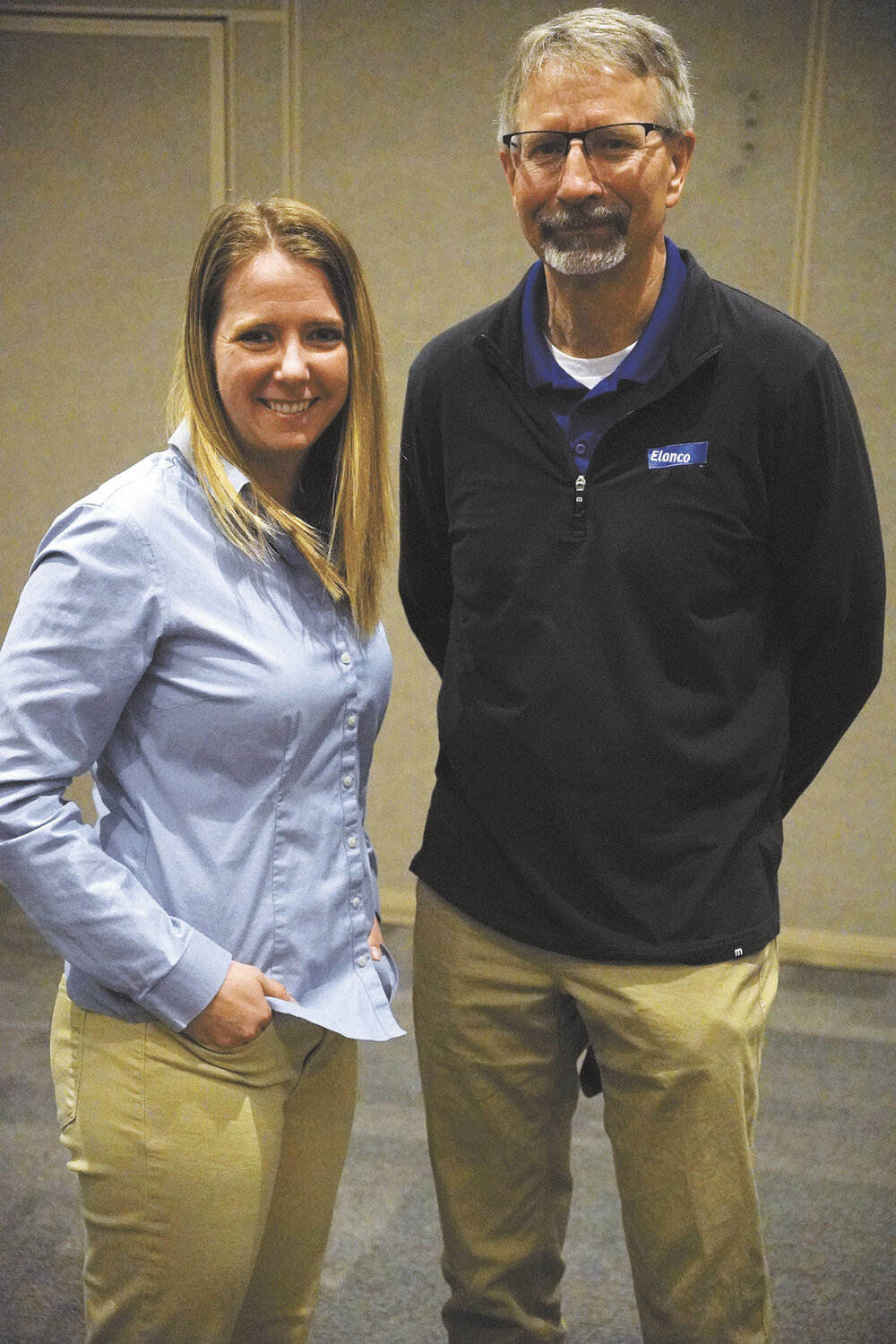
Kevin Dhuyvetter and Sara Kvidera, both with Elanco Animal Health, look at ways farmers can tap into sustainability initiatives. They shared tips during their presentation, “Credit for Good: Producer Pathways to Profit for Sustainable Practices,” March 27 at the Central Plains Dairy Expo in Sioux Falls.
Many Fortune 500 companies and consumer packaged goods brands are actively seeking ways to reduce their environmental impact, often through partnerships with the agriculture sector.
“About two-thirds of all Fortune 500 companies have set significant climate reduction goals, and when you’re a publicly traded company and you make a commitment to do something, you’re under a legal obligation to fulfill that commitment,” Kvidera said.
This is where dairy farmers can come into play.
Kvidera, dairy sustainability technical lead at Elanco, said the dairy industry has reduced the emission intensity of milk production by about 40% since 1990.
“This decrease in intensity is mostly due to our ability to be more productive and produce more milk,” Kvidera said. “If I only said emissions, not emissions per unit of milk, emissions would be going up because we are growing, we’re making more milk, we’re producing more.”
From an economic perspective, the dairy income landscape has shifted over the last decade.
“Milk is still the primary source of revenue on most dairies, but we know that milk as a share of the income generated on dairy (farms) is going lower and lower,” Dhuyvetter said.
When looking at income sources on dairy farms — especially in recent years — beef calf sales have made up a growing percentage, driven by current market prices. There are also income opportunities tied to sustainability initiatives, such as installing a digester.
However, Dhuyvetter said that digesters are sometimes not included in a dairy farm’s accounting records if they are treated as a separate business, making it difficult to quantify their magnitude on dairy income.
He said that while diversification is valuable for additional income, it should not compete with the core focus of the farm’s primary business.
“Your core business is making milk,” Dhuyvetter said. “If you diversify and it competes with that, (be) a little nervous of that… What we really want to (do) is to diversify so that it really complements (the farm).”
In the past, dairy farms often included various livestock species, but today, many are specialized with opportunities related to the dairy farm. That is why sustainable practices should be approached strategically, he said.
Manure management is one area where farmers can reduce environmental impact. Others include feed management, energy use and enteric methane emissions.
Elanco, among various other agriculture commodities and related groups, hopes to be the connection point from farmers to companies in today’s sustainability-driven environment.
“You sell milk to a processor,” Kvidera said. “A processor sells it to a food company and the money goes back to the producer. What we’re trying to do is open a whole new revenue stream that’s independent of milk markets for you.”
Verification, she said, is important to ensure transparency and accuracy of what is being done.
“A producer will send their data to get verified…the third parties in the world verify that what you did on your farm adheres to the right standards, and then they sell those reductions to food companies,” Kvidera said.
More than 1 million cows, or over 11% of the U.S. dairy herd, are now enrolled in Elanco’s UpLook database — the company’s digital solution for quantifying greenhouse gas emission reductions and the first step in enabling farmers to monetize their on-farm interventions, Kvidera said.
“Know what opportunities exist in your area,” she said. “This can be very milk dependent. It can be state dependent. Talk to your supplier, your nutritionists, your advisors on what opportunities exist in your area today.”
Likewise, Dhuyvetter said to consider whatever idea the revenue stream may bring and understand if it competes with or complements your core business.
“Know what’s generating the income, and what costs it’s generating,” Dhuyvetter said. “Is the decision reversible if conditions change? Does it allow a lot of capital investment? Is this part of the dairy, or is this completely separate?”
As farmers look ahead in 2025, Kvidera said they should look for opportunities while remaining in control of their practices.
 |
 |
 |
 |
Share with others


Comments
No comments on this item Please log in to comment by clicking here