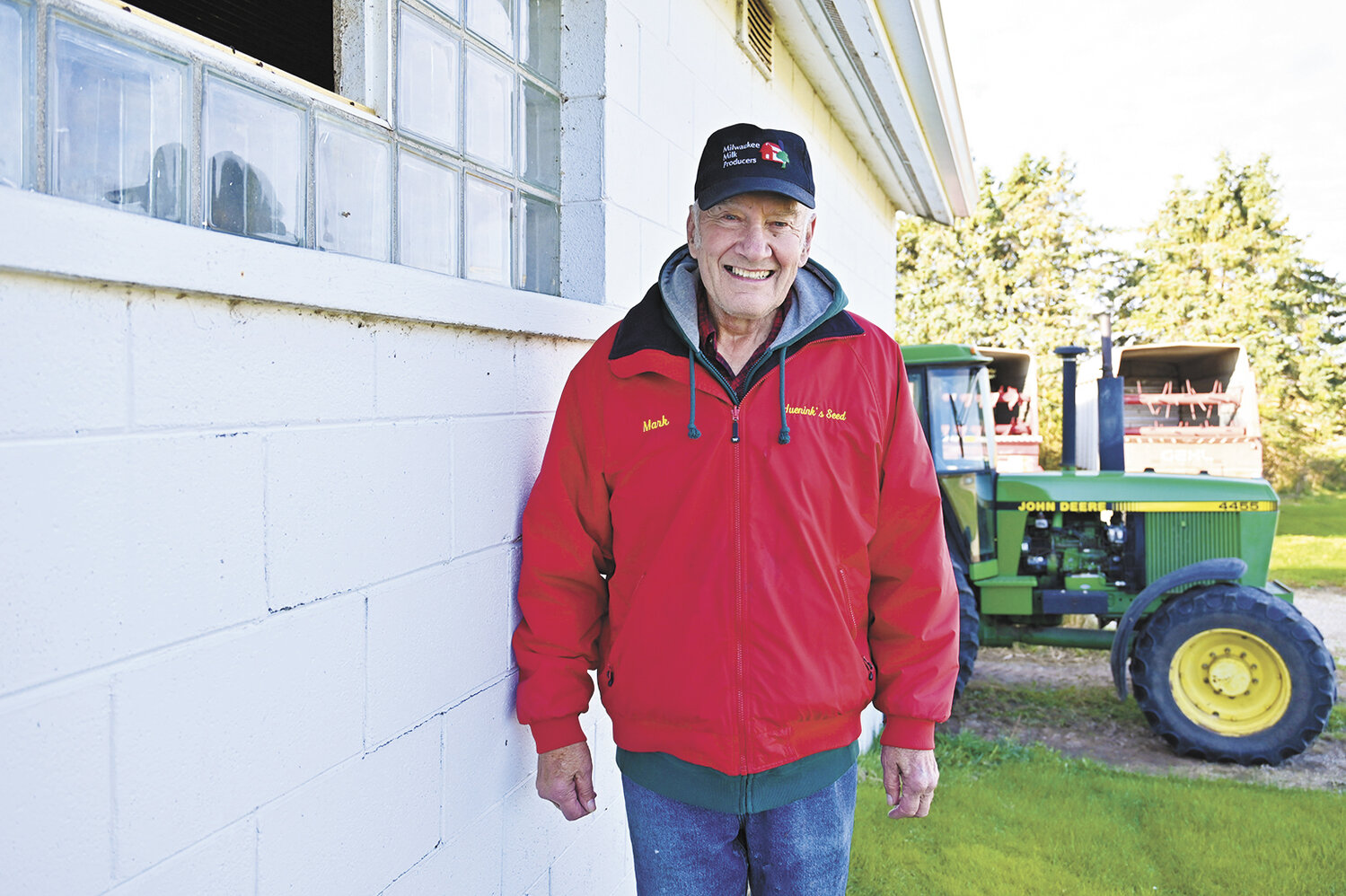
Mark Huenink
Cedar Grove, Wisconsin
What year did you start farming, and what year did you retire? I started farming in 1972 upon graduating from the University of Wisconsin-Madison with a bachelor’s degree in dairy science. I milked cows for 51 years. I retired from dairy farming Aug. 22, 2023, which was the day the cows left the farm.
Tell us about your farm when you started and describe what it looked like when you retired. When I started farming in partnership with my father, Wilfred Huenink, we milked about 35 cows in Surge buckets, and our milk was shipped for fluid milk to Borden’s in West Allis. At that time, we farmed 187 acres of land. The most cows we milked were around 105. When I retired, we were milking 76 cows and shipping our milk to Cedar Valley Cheese in Belgium, where it was made into mozzarella cheese. At my retirement, we were farming 500 acres of land.
What were some of the big advancements you made during your career? In the early 1970s, we installed a pipeline milking system and built a 20-by-70 concrete tower silo. We added another 20-by-72 silo in the early 80s. In 1980, we expanded the barn from 35 stanchions to 76 tie stalls and added 30 free stalls for heifers, hutches for baby calves and maternity pens for fresheing cows.
What did you love about milking cows? I loved working with dairy cows. They are amazing animals — being able to transform all that grass and forage into the delicious and nutritious dairy products we all enjoy. I enjoyed the experience of being up close and personal with my dairy cows. Working with them in a stall barn gives the dairy farmer a close connection to their cows, and I think that is partly why I never transitioned to a freestall barn or milking parlor.
What was the highlight of your dairy career? I would say the highlight of my dairy career was being able to work with family all these years. My great-grandfather purchased the farm, and I was able to work with my grandfather; my father and mother; my wife, Mary; and our three children, Brian, Joel and Ann — and then with Brian and his wife, Jill, and their four children, Will, Weston, Carsten and Ruth. These four grandchildren are now the sixth generation on the farm.
What is the biggest challenge you faced in your career and how did you overcome it? One of the biggest challenges I faced in my career was when my parents had passed on and all my children had left the farm. I was deciding if I should sell the cows. A conversation with my oldest son, Brian, provided the answer: He and his wife and two little boys were living in Iowa at the time where he was working as a design engineer for John Deere. Brian said, “Dad, don’t sell the cows. I want my kids to grow up on the farm.” It reminded me of the saying, “You can take the boy off of the farm, but you can’t take the farm out of the boy.” Brian was able to keep his job with John Deere, designing tractors by working remotely from his office on the farm, and he was also able to help me with the farm work. Another challenge came about a year later when I was diagnosed with cancer, but in God’s perfect timing, with Brian back on the farm and my loving wife taking on a bigger role with the cows, the work continued to get done. After surgery to remove a tumor at St. Luke’s in Milwaukee and spending five days there recovering, the nurses learned a lot about dairy farming and asked a lot of questions. This was followed by six months of intensive chemotherapy and another 2-plus years of more infrequent chemo. I was fortunate because I never really got sick from the chemo and have been and continued to work on the farm going on 14 years since the cancer.
If there is one thing you wished you could have done differently during your farming career, what would it be? I suppose if we had expanded to 500 cows with a freestall barn and robots, we would still be milking cows today.
What piece of equipment or technology has been introduced that you wish you had for your dairy career? For medium to large herds, the freestall barn with robots seems to work well. For really large herds, the carousel parlor can milk a lot of cows.
What do you miss most about dairy farming? I always tell people when they ask if I miss being a dairy farmer, “I miss the cows, but I do not miss the work.” But, truthfully, I do miss all the people one works with every day operating a dairy farm, like the milk hauler, the inseminator, the veterinarian, the nutritionist, etc.
What advice would you give to a young farmer today? Work for a progressive farmer and learn all you can from him or her. Maybe even work for several farmers and that might lead to an opportunity to partner with one of them to start your own farming career. Another path might be to attend a technical school or get an ag degree from a college. There is more than one way to get started but if dairy farming is your passion, you will find a way. There could also be some assistance for young farmers at places like the Farm Service Agency.
What is your tie to the dairy industry today? Our family continues to support organizations like the Sheboygan County Dairy Promotion Association and Farm Bureau. Our daughter, Ann, is on the Wisconsin State Fair Dairy Promotion Committee and is in charge of the grilled cheese stand at the Wisconsin State Fair. I still enjoy reading publications like the Dairy Star, Hoard’s Dairyman, Progressive Dairy and others. Mary and I like to attend dairy shows like World Dairy Expo, Wisconsin State Fair, Sheboygan County Fair and other farm shows. My grandson, Carsten, showed a Holstein heifer at the Wisconsin State Fair this year, and he and my granddaughter, Ruth, exhibited their Holstein calves at the Sheboygan County Fair.
Was retiring an easy or hard decision/transition? Retiring from an occupation or career that you enjoyed doing for so long is never easy, but two things made it easier. The first was my age; I knew it was time to quit. The second and maybe just as important to me was finding a good home for my cows. My family was in agreement to sell the cows. I knew of a local farmer, Dan Mullikin, who was looking to expand his herd. I asked Dan and his wife, Shelly, if they would be interested in buying a herd of Holstein dairy cattle, and they were. Dan and Shelly have two sons and a daughter and never thought they would all want to be a part of the dairy operation, but they all did, and they were all getting married in a short period of time. The dairy farm was going to have to help support four families instead of one, so they needed to milk more cows. Their daughter, Jess, said to me, “Mark, we have been praying that a local farmer would want to part with his cows. You are an answer to our prayers.” With that, I knew my cows had a new good home, and it reminded me of a Bible verse from Romans 8:28, “And we know that in all things God works for the good of those who love him.”
What have you been doing since you retired? One thing I do not do since retiring from milking cows is get up at 4:30 every morning. We are in the process of transitioning to a beef cow/calf operation. We had been breeding a number of our Holsteins to Angus, so we had some crossbred cattle from those matings. We also had an agreement with the Mullikins that, as they purchased our springing heifers, we would get the crossbred calves. That gave us a good start to our crossbred beef herd. We also are Wisconsin Certified Seed producers, which occupies quite a bit of our time.
 |
 |
 |
 |
Share with others


Comments
No comments on this item Please log in to comment by clicking here