
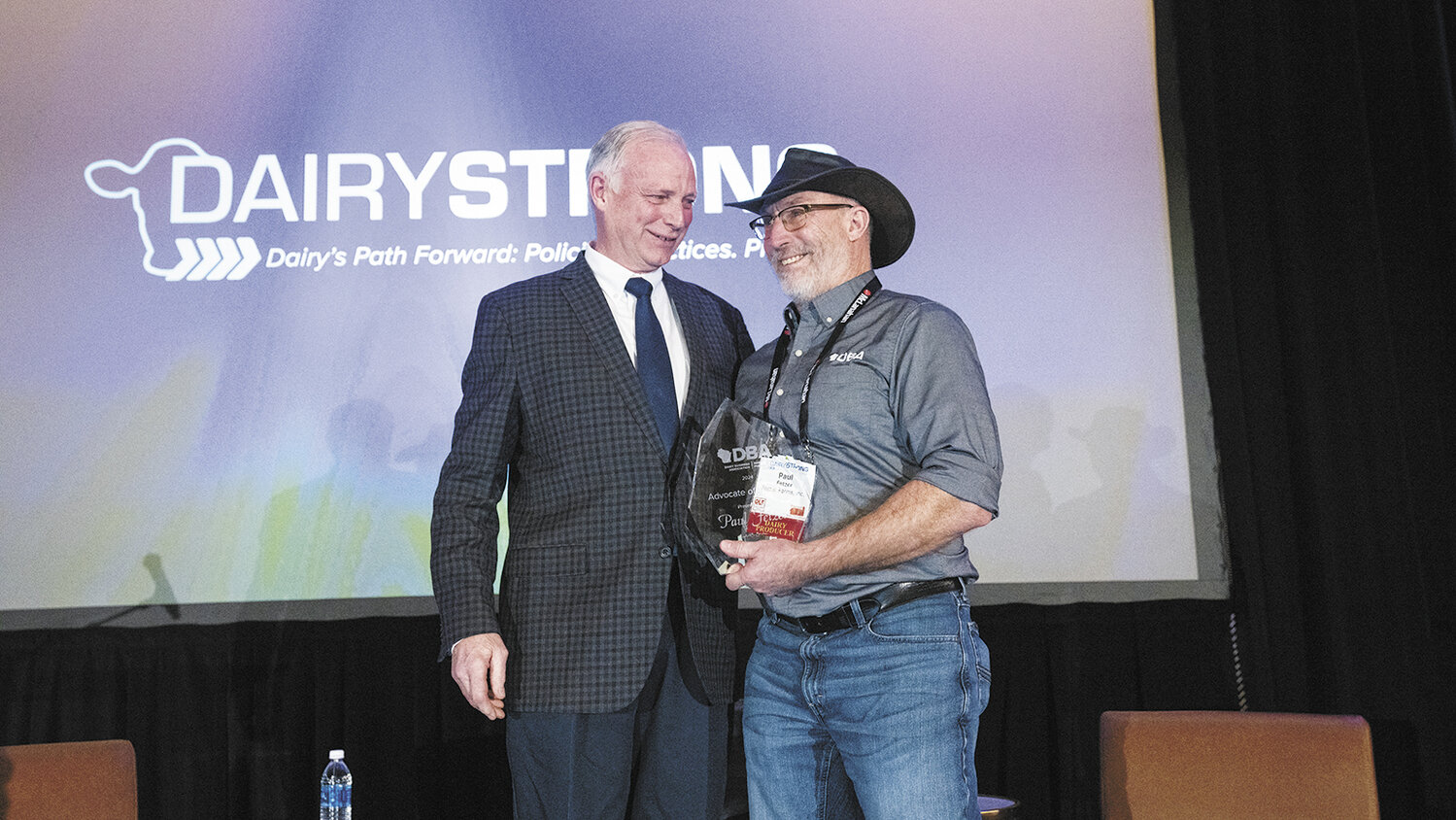


ELMWOOD, Wis. — A month ago, Paul Fetzer found himself in a familiar spot, sitting next to his wife, Char, at the Dairy Business Association’s Dairy Strong conference in Green Bay. After serving on the board for nine years, the now retired Fetzer felt he owed it to the board to sit in on proceedings and the yearly award ceremony. When the emcee began describing this year’s Advocate of the Year, Fetzer dropped his head, and the tears started to flow.
Fetzer was named the winner of the DBA 2024 Dairy Advocate of the Year award sponsored by the Vita Plus Corporation.
“This wasn’t anything I expected,” Fetzer said. “I just thought I was doing what I needed to do. I didn’t have any clue that they would be honoring me with that award.”
Fetzer realized he was the winner when the emcee said he farms with his brothers, Steve and Joe, at their 1,400-cow dairy in Elmwood. He said he could not believe his ears and immediately doubt crept in.
“Am I really that deserving?” Fetzer said. “Have I done that much? Other people have done as much, if not more than me. There’s a lot of good people out there, so when they decided to choose me, it was extremely humbling.”
Fetzer regained his composure and walked to the stage to accept his award where he thanked as many people as he could during his impromptu acceptance speech.
“I tried to recognize all the people that had worked with our farm through the years,” Fetzer said. “We wouldn’t be where we are today without them.”
Fetzer’s father, Bob, was an active member of the DBA and was the unofficial face of Fetzer Farms. After his passing in 2004, Fetzer filled the role vacated by his father.
“I started going to the Dairy Business Association meetings and getting more involved after Dad passed,” Fetzer said. “Dad was outspoken in the DBA when it formed and was part of the core group when they would talk about growing farms. I thought it was important that we continued to have a presence in that.”
Fetzer Farms has seen continuous expansion. In 1968, Fetzer Farms was a 60-cow herd. Today, they are milking 1,400 cows three times a day in a double-20 parallel parlor.
Fetzer, along with Steve and Joe, host people from all over the world at Fetzer Farms Inc. Though their hospitality they provide learning opportunities for local schools and universities and act as a representative of the Wisconsin dairy industry.
As part of his work with the DBA, Fetzer made a plethora of trips to Madison to advocate for the dairy industry with legislators.
“There are so many people who aren’t involved in agriculture anymore and don’t understand it,” Fetzer said. “We need people to understand agriculture, so it remains viable.”
Educating government officials and their representatives became an important factor for Fetzer during his time with the DBA.
“If we don’t keep up with politics, it’ll run us over,” Fetzer said. “It’s a humbling experience to talk with legislators and to get your point across. Their experience with agriculture varies. The more consumers and legislators get away from the farm and aren’t exposed to it anymore, the more important it is for us as dairy people to be there to tell them what’s going on and why we need their support.”
The Fetzers have hosted the Pierce County Dairy Breakfast and groups from Pepin Area Schools, the University of Wisconsin–River Falls and the University of Minnesota. The Fetzers have continued to transform the farm with new technologies and practices which are on display during the tours.
“Bringing students to our farm helps give them firsthand training on something that’s fairly up to date,” Fetzer said. “It gives them experiences with something they might not have seen before if they don’t come from a dairy background or if they haven’t seen a larger dairy facility.”
With the continued expansion, Fetzer Farms has evolved its approach to dairy cattle and cow comfort. They use a radio frequency identification system for better data collection, motion detection for more accurate heats and monitoring movement and rumination, which leads to an increased pregnancy rate. Fetzer Farms has also been on the ground floor of genomic testing, leading to different breeding strategies and ideas.
Cow comfort improvements include a tunnel-ventilated heifer facility, a cross-ventilated barn with sand bedding, sand wash equipment and a sand reclamation system. A freestall barn features an under-barn manure pit.
“We’ve always tried to be on the leading edge of new technology and strategies, or tried to keep up with them,” Fetzer said. “As an industry, we’re so much better at cow comfort than we used to be 40-50 years ago. We learned how to take care of cows so much better than before.”
By continuing to evolve their practices, Fetzer Farms has been an example of how the dairy industry has modernized and progressed with new technologies.
“It’s important for people to see how cows are raised,” Fetzer said. “There’s been a tremendous amount of improvement in new technology that has emerged to help us produce more and more quality product.”
Expansions throughout the history of Fetzer Farms enabled family members to come back to the farm. Fetzer and Steve joined Joe on the farm in 1993. Now, Steve’s daughter, Alicia, and Fetzer and Steve’s nephew, Brent, are two of 30 full-time employees.
Fetzer retired from the farm in 2023, 30 years after he returned, but the calling of supporting the industry that has been part of his family for over a century remains strong.
“We need dairies, so I’m going to continue doing what I can for the dairy community,” Fetzer said. “When people call and ask for a tour of the farm, I’ll talk with Steve and Joe about bringing them out. It’s important for us to continue to educate people about our industry and the advances we’re making.”
 |
 |
 |
 |
Share with others


Comments
No comments on this item Please log in to comment by clicking here