
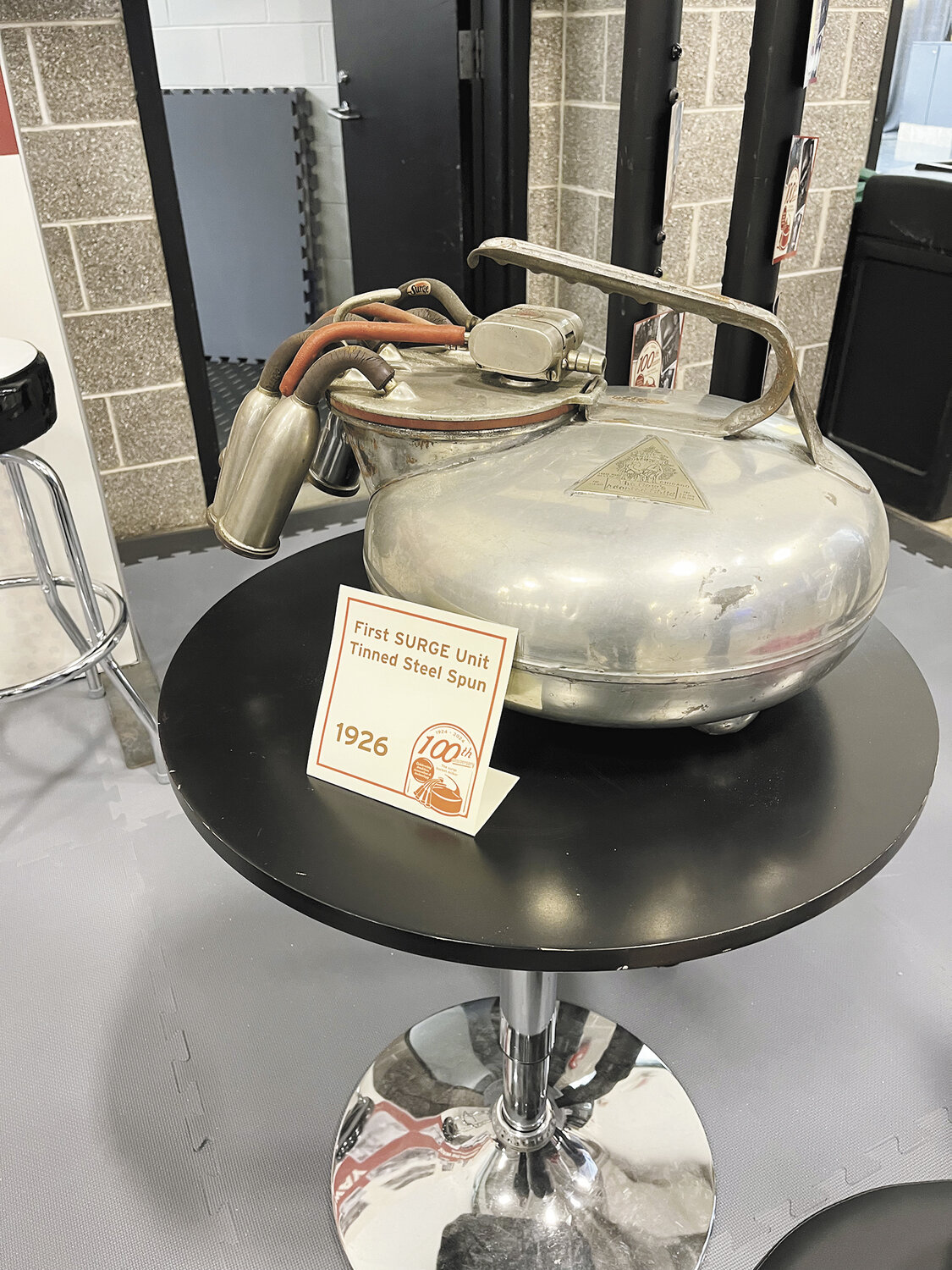


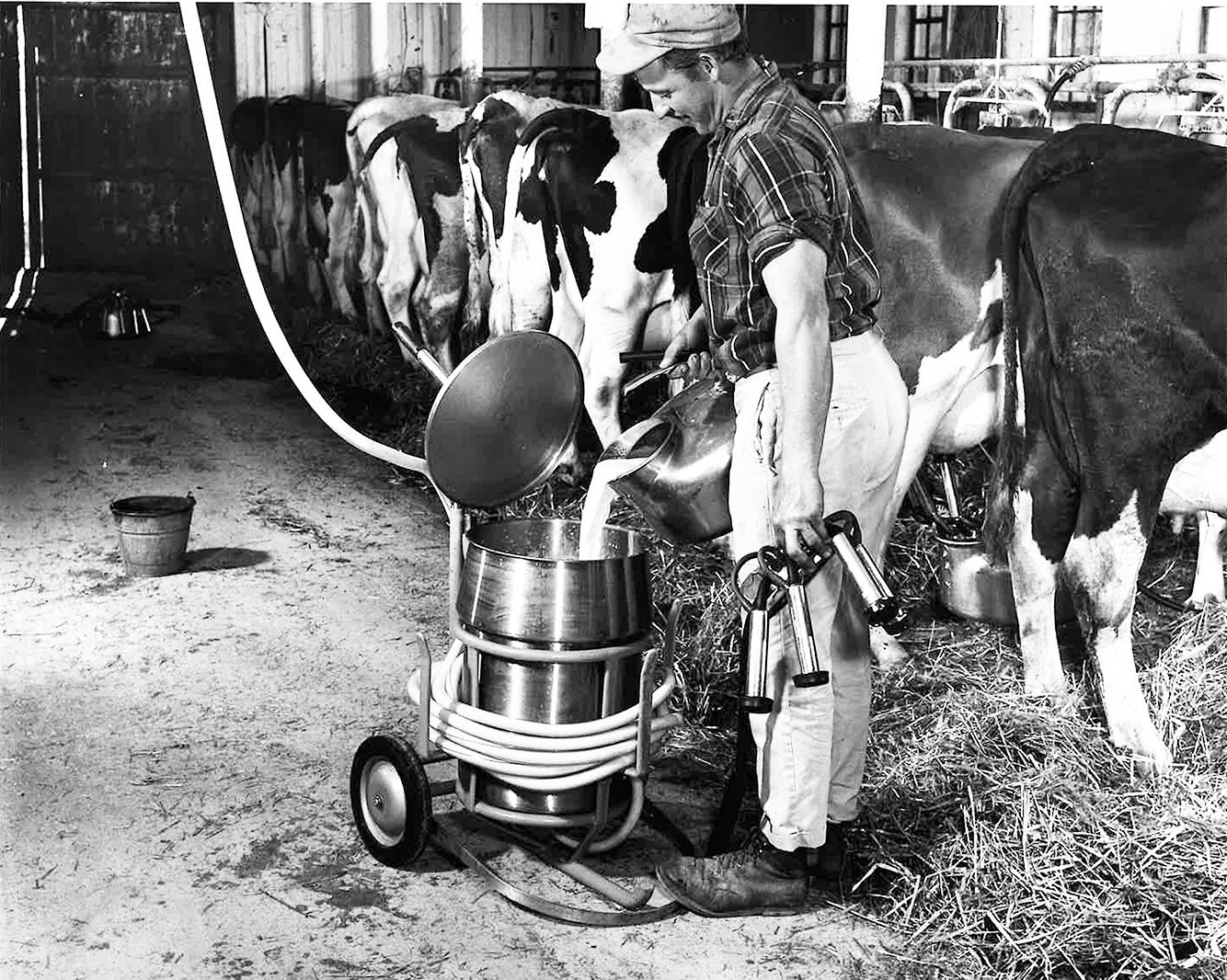


Last year, an icon in dairy farming celebrated its 100th birthday. When the product was launched in 1924, it provided a reprieve from milking cows by hand while also surpassing primitive means of automation available at the time.
Many farmers were attracted to the new milking method that enhanced efficiency and productivity on the farm. Farmers could extract more milk from each cow in less time and with less sweat. Various qualities made the Surge bucket milker, which eventually owned three-quarters of the market, a superior milking device of its time.
“With its smooth steel spun pail, the Surge bucket milker was the first easy-to-clean milker,” said Robin Matthayasack of GEA Farm Technologies. “It had the first truly dependable pneumatic pulsator mounted only a few inches from the udder, with the first one-piece inflation and shell assembly that could be taken apart in seconds.”
Matthayasack is director of marketing and communication for North America at GEA Farm Technologies, the company that acquired the Surge brand years ago.
Originally invented by Herbert McCornack in 1922, the bucket was dismissed by many companies as impractical before finding a home with Babson Bros. Co. of Chicago, Illinois. The Babson brothers saw its potential and spent two years refining the product before launching it in the marketplace. Fred Babson’s Four Pine Farm near Hinsdale, Illinois — which became famous for its elite registered Guernsey herd — was the site of extensive testing on the Surge bucket.
What made McCornack’s invention unique was that it utilized teat cups featuring short, easy-to-clean tubes attached directly to a bucket that hung underneath the cow. The one-point suspension of the bucket, hung using a strap or surcingle as it became known, generated a strong milking or surging action as the milker moved backward and forward while milking.
“The tug and pull movement of the milker was similar to the tugging and pulling of a sucking calf,” Matthayasack said. “That surging back and forth action is how the name Surge came to life.”
With 8 inches from the teat to the pail and only four pieces of rubber to wash, the Surge bucket milker was a milking innovation that altered the course of the dairy industry.
The short milk tubes, which took milk from the cow to the bucket, were a solution to the many sanitation problems of floor-type machines used at the time, Matthayasack said. These older machines included long hoses that were difficult to keep clean and affected milk quality. Instead of 8 feet of hose used on pail units, the Surge bucket milker had only 8 inches of rubber in the inflation.
Furthermore, the Surge milker prevented falling teat cups from sucking up debris, and the adjustable positioning of the unit under the cow promised faster, safer milking.
“It simply milked cows faster than anything else because of the superior vacuum stability in the unit,” Matthayasack said.
The Surge bucket evolved throughout the decades as tweaks in size, materials and features made the milker more robust. The first Surge bucket was made from tinned steel. Next, came the aluminum bucket and finally, the stainless-steel bucket in 1936. In 1947, the first 18/8 seamless stainless-steel Surge bucket milker came off the production line. A looking-glass finish, inside and out, was introduced in 1958.
The size of the bucket grew to accommodate milk production increases. The 1936 bucket milker held 41.5 pounds of milk; the 1948 model held 45.6 pounds; and the 1958 model had capacity for 50.75 pounds of milk.
Babson Bros. backed its Surge milker with a service program that promised a visit from a dealer who would provide parts and service at least once per year to maintain peak operating efficiency.
By 1930, the company had 10 locations in the U.S. and Canada to support its growing dealer network. The Surge bucket came with a 3-year warranty and rustproof guarantee.
For a brief period during WWII, when steel was reserved for the war and metals were hard to obtain, Babson Bros. tried to make the bucket out of plastic. But, the plastics of the time did not hold up, so these buckets were reserved for tradeshows and demonstrations.
At the peak of its popularity in 1955, the Surge bucket milker had a 76% market share in the U.S. When its patent ran out that same year, others tried to copy its success.
Babson Bros. continued to make improvements to their product, and in 1962, an adjustable electric pulsator was added to the Surge bucket milker. This gave dairymen a choice of three different pulsator speeds and a 50-50 or a 60-40 milking-rest ratio.
The quarter-take-off was designed during the 1960s as well, a feature that helped avoid overmilking by automatically detaching individual cups as each quarter finished.
Sales of the SURGE bucket reached well over one million units. When the one-millionth bucket came off the line in the 1950s, the company gold-plated it, and the lid resides in the Surge museum at GEA Farm Technologies.
After years of ruling the market, the Surge bucket faced its biggest competitor during the 1960s that would ultimately lead to its demise. At that point in history, pipeline milking systems became the preferred way to milk cows in North America. Starting in 1975, sales of the Surge bucket milker began to decline, and in 1999, production ended.
However, the legacy of the Surge bucket lives on with milkers still in use on smaller operations and hobby farms. From its unique design to its reliable functionality, the Surge bucket milker is known for revolutionizing the dairy industry as it paved the way for today’s milking innovations.
 |
 |
 |
 |
Share with others


Comments
No comments on this item Please log in to comment by clicking here